The riveting defect in the figure shown is
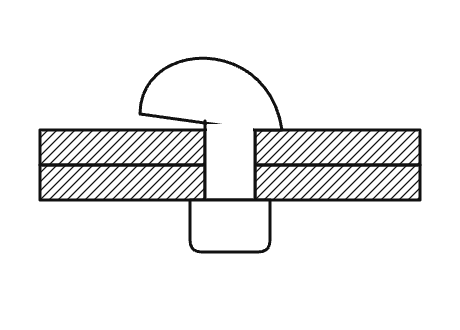
- excessive hammering on the rivet head.
- the dolly was held at an angle.
- the snap was not square.
Explanation from PART66Online
The head formed by the snap is lopsided: it sits off-centre on the shank, seated hard against the skin on one side and lifted clear of it on the other. That is what happens when the snap is not held square to the rivet. Excessive hammering flattens or cracks the head evenly instead of tilting it, and a dolly held at an angle would spoil the manufactured head on the other side of the joint, which here is square.
A
albalushi asked · 17 Apr 2012
explain please :)
Community Comments (1)
P
PART66Online
17 Apr 2012
Please Sign In to post a comment.
More discussions in 7. Maintenance practices
- The length of a hose assembly with elbowed end fittings is taken from
- When manufacturing aircraft control cables, the cable can be cut by
- The sharpest bend that can be placed in a piece of metal without critically weakening the part is called the
- An aircraft has been reweighed and a new report certified. Where does the superseded report belong?
- When using a D.T.I. to check the run-out of a shaft, readings of -15 to +25 would indicate a run-out of
- Galvanic corrosion refers to a type of