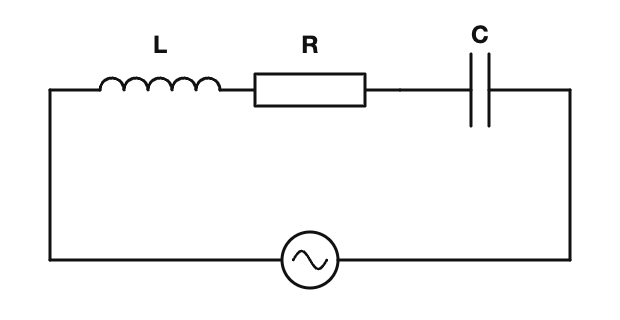
In the circuit shown, if the frequency is increased from zero to resonant frequency, the circuit current would
- increase.
- decrease.
- stay the same.
Explanation from PART66Online
At zero frequency (DC) the capacitor's reactance is infinite and it blocks current completely, so the circuit current is zero. As the frequency rises, XC = 1 / (2 x pi x f x C) falls and XL = 2 x pi x f x L rises. Below resonance XC is the larger, so the net reactance (XC - XL) shrinks and the impedance falls. At resonance XL = XC, the two cancel, the impedance is just R and the current is at its maximum. Between zero and resonance the current therefore increases.
A
arifadli8 asked · 27 Dec 2013
please explain...
Community Comments (1)
T
tsukiyo92
31 Jul 2014
This as simple to state, is called 'acceptor circuit', which have minimum impedance at resonant frequency.
Thus at non-resonant frequency, the current is lower than at resonant circuit.
Thus at non-resonant frequency, the current is lower than at resonant circuit.
Please Sign In to post a comment.
More discussions in 3. Electrical fundamentals
- The true power developed in this circuit is
- What is the reflected impedance in the primary of the transformer circuit shown?
- The input is 115V and is applied across the 300 turn portion of the autotransformer shown. What is the output voltage?
- The circuit shown is at resonance. If the value of the inductance is trebled, the impedance will
- In what equipment is a photon radiated when an electron leaves a hole?
- The smallest particle that a substance can be split and show the same properties as the whole is known as