Module 14 — Propulsion
14.1(a) — Turbine Engines
On this page (13)
- Introduction to Gas Turbine Engines
- Fundamental Energy Concepts
- Bernoulli's Principle and Gas Laws
- Force, Work, Power and Torque
- The Brayton Cycle
- Newton's Laws Applied to Jet Propulsion
- Engine Types
- Bypass Ratio
- Engine Constructional Arrangement
- General Engine Requirements and Performance Parameters
- Thrust Reversers
- Lubricants, Fuels, Lubrication Systems and Fuel Systems
- Accessory Gearbox, Bearings, and Seals
Introduction to Gas Turbine Engines
The gas turbine engine is the dominant powerplant for modern commercial, military, and many general aviation aircraft. It operates on the Brayton cycle (also called the gas turbine cycle or constant-pressure combustion cycle) and produces either thrust (turbojet/turbofan) or shaft power (turboprop/turboshaft) by accelerating a mass of air.
Fundamental Energy Concepts
Potential Energy: Energy stored due to position or state. In propulsion context: chemical potential energy in fuel, pressure energy in compressed air.
\[ PE = mgh \quad \text{(gravitational)} \]
Kinetic Energy: Energy of motion. This is what produces thrust — accelerating air rearward.
\[ KE = \frac{1}{2}mv^2 \]
A jet engine converts chemical energy (fuel) → heat energy (combustion) → kinetic energy (high-velocity exhaust).
The engine as an energy converter, not an energy source
The first law of thermodynamics says energy can be neither created nor destroyed, only changed in form. A gas turbine therefore creates nothing: it is a machine for taking the chemical energy locked in a hydrocarbon fuel and handing as much of it as possible to the surrounding air as useful momentum. Every stage of that hand-over is imperfect, and understanding where the energy is lost is what separates a Level 3 answer from a recited definition.
Aviation kerosene carries a lower calorific value of roughly 43 MJ per kilogram. That figure is worth committing to memory, because it lets you sanity-check almost any engine performance claim: multiply the fuel flow in kg/s by 43 MJ/kg and you have the total rate at which energy is being released inside the engine. Everything the engine does for the aircraft has to come out of that number, and in practice well under half of it does.
Worked example — how much of the fuel's energy actually moves the aircraft
A large turbofan in the cruise burns 1,150 kg of fuel per hour while producing 22 kN of net thrust at a true airspeed of 240 m/s.
Fuel energy released: \( \dot{m}_f = 1150 / 3600 = 0.319\ \text{kg/s} \), so \( 0.319 \times 43 = 13.7\ \text{MW} \).
Useful propulsive power delivered: \( P = F \times V = 22\,000 \times 240 = 5.28\ \text{MW} \).
Overall efficiency: \( 5.28 / 13.7 = 0.385 \), i.e. about 38.5%.
The other 61.5% leaves as hot exhaust, as kinetic energy still in the jet wake, and as friction, leakage, cooling-air and noise losses. An overall efficiency near 40% is excellent for a heat engine — but it means that for every tonne of fuel burned, roughly six hundred kilogrammes' worth of energy is thrown away as heat and turbulence.
Pressure energy: the reason the compressor exists
Pressure energy is the least intuitive of the stored forms, but it is the one the whole cycle is built around. Compressing air does not add any fuel to it, yet it makes the fuel that is added later far more valuable. The reason is that the work you can recover from a gas by expanding it depends on the ratio of the pressure you start from to the pressure you finish at. Burn fuel in air at atmospheric pressure and the hot gas has nowhere useful to expand to. Burn the same fuel in air that has already been squeezed to forty times atmospheric pressure and the gas can expand through a pressure ratio of forty on its way back out, doing work on a turbine the whole way down.
This is why the compressor absorbs an enormous share of the engine's internal power. On a turbojet the great majority of the work the turbines produce goes straight back into driving the compressor, and only what is left over leaves as jet thrust; on a high-bypass turbofan or a turboprop the turbines are sized to extract a large additional share of the gas power specifically to drive the fan or propeller, so that share is not a leftover at all. It is also why compressor damage is so serious: a compressor that has lost efficiency does not merely fail to compress, it consumes more turbine work to achieve less pressure, and the shortfall shows up as a higher gas temperature for the same thrust.
Why kinetic energy is expensive, and why that shapes every engine
Thrust and wasted energy do not scale the same way, and this single fact drives the entire evolution of the turbofan. Thrust is proportional to the change in velocity given to the air — it is a linear relationship. The kinetic energy left behind in the jet is proportional to the square of that velocity change. Doubling the velocity change doubles the thrust but quadruples the energy dumped into the wake.
Thrust obtained (linear in velocity change):
\[ F = \dot{m}\,\Delta V \]
Kinetic energy given to the air per second (quadratic in velocity change):
\[ \dot{E}_{K} = \tfrac{1}{2}\,\dot{m}\,\Delta V^{2} \]
Because \( F \) rises with \( \Delta V \) but \( \dot{E}_K \) rises with \( \Delta V^{2} \), the cheapest way to buy a given thrust is always to take the largest possible mass of air and give it the smallest possible velocity change.
Worked example — same thrust, half the energy
Option A: accelerate 100 kg/s of air by 400 m/s.
Thrust \( = 100 \times 400 = 40\,000\ \text{N} = 40\ \text{kN} \). Wake energy \( = \tfrac{1}{2} \times 100 \times 400^{2} = 8.0\ \text{MW} \).
Option B: accelerate 200 kg/s of air by 200 m/s.
Thrust \( = 200 \times 200 = 40\,000\ \text{N} = 40\ \text{kN} \). Wake energy \( = \tfrac{1}{2} \times 200 \times 200^{2} = 4.0\ \text{MW} \).
Identical thrust, but Option B throws away exactly half the energy. It needs twice the airflow to do it, which is precisely why a modern engine has a fan two or three metres across bolted to the front of a comparatively small core.
Following the energy through a turbofan
It helps to think of the fuel's 43 MJ/kg as being spent in a fixed sequence, with a deduction at every step:
- Combustion losses. Modern combustion is very nearly complete, so only a small fraction of the fuel's chemical energy fails to be released as heat. This is the smallest of the deductions.
- Turbine work taken back by the compressor. The largest internal transfer in the engine. It is not a loss — the energy is stored back into the air as pressure — but it is unavailable for propulsion.
- Turbine work taken by the fan or propeller. On a high-bypass turbofan or a turboprop this is where most of the useful output goes.
- Cooling and sealing air. Air bled from the compressor to cool turbine blades and pressurise bearing chambers has been compressed at full cost but bypasses the combustor, so it contributes little or nothing to the cycle work. It is a deliberate, unavoidable penalty paid to allow a higher gas temperature.
- Residual kinetic energy in the jet. Any exhaust moving faster than the aircraft carries away kinetic energy that the aircraft never uses. This is the loss that propulsive efficiency measures.
- Rejected heat in the exhaust. By far the largest single deduction. It is inherent to the cycle rather than a defect: a heat engine must reject heat at the cold end, and in an open-cycle gas turbine the atmosphere is the cold end.
- Friction, leakage, windage and noise. Small individually, but they are the losses maintenance can influence — worn seals, opened tip clearances and eroded aerofoils all show up here.
Exam framing: a question that asks what "produces" thrust is testing whether you understand the engine as a converter. The engine does not manufacture a force out of nothing; it changes the momentum of a mass of air, and thrust is the reaction to that change. Every energy-related answer in this module should be traceable back to the chain of conversions above.
Bernoulli's Principle and Gas Laws
A gas turbine is, in engineering terms, a machine for trading three quantities against one another: pressure, velocity and temperature. Almost every component in the engine exists to make one of those trades in a controlled way. Two separate bodies of theory govern the trade. The gas laws describe the state of the air — how its pressure, volume and temperature are related when it is squeezed or heated. Continuity and Bernoulli's principle describe the flow — what happens to pressure and velocity when that air is pushed through a duct that changes shape. You need both to explain any part of the engine.
The gas laws
| Law | Statement | Held constant | Where you meet it in the engine |
|---|---|---|---|
| Boyle's law | Pressure is inversely proportional to volume: \( P \propto 1/V \) | Temperature | The idealised squeeze of a gas — the starting point for understanding compression, though no compressor is isothermal in practice. |
| Charles's law | Volume is directly proportional to absolute temperature: \( V \propto T \) | Pressure | The combustion chamber. Heat is added at nominally constant pressure, so the gas must expand — and since it cannot expand sideways in a fixed duct, it expands by speeding up. |
| Pressure law (Gay-Lussac) | Pressure is directly proportional to absolute temperature: \( P \propto T \) | Volume | Any sealed volume that gets hot — a bearing chamber, a closed bleed duct, a tyre. Trap a fixed mass of air in a rigid vessel and heat it, and the pressure climbs in direct proportion to the absolute temperature, because no change in volume is available to relieve it. Apply it only where the volume genuinely is fixed: the temperature rise across a compressor is not this law, because there the volume is deliberately reduced and work is done on the gas. |
| Combined gas law | \( PV/T \) is constant for a fixed mass of gas | Mass of gas | Comparing conditions at two stations in the engine, e.g. compressor inlet versus compressor delivery. |
| Characteristic gas equation | \( P = \rho R T \), with \( R = 287\ \mathrm{J\,kg^{-1}K^{-1}} \) for dry air | — | The single most useful relation in engine performance: it converts a pressure and a temperature straight into a density, and density is what mass flow — and therefore thrust — depends on. |
Density from pressure and temperature
\[ \rho = \frac{P}{R\,T} \]
\( P \) in pascals, \( T \) in kelvin (never degrees Celsius), \( R = 287\ \mathrm{J\,kg^{-1}K^{-1}} \) for dry air.
Absolute temperature: \( T\ (\text{K}) = t\ (^\circ\text{C}) + 273 \).
Worked example — why thrust falls on a hot day and at altitude
ISA sea level (15 °C, 101.3 kPa):
\( \rho = 101\,300 / (287 \times 288) = 1.225\ \text{kg/m}^3 \) — the standard sea-level density.
Same pressure, ambient temperature 40 °C (313 K):
\( \rho = 101\,300 / (287 \times 313) = 1.128\ \text{kg/m}^3 \) — about 8% less dense.
ISA tropopause, 11,000 m (−56.5 °C = 216.7 K, 22.6 kPa):
\( \rho = 22\,600 / (287 \times 216.7) = 0.363\ \text{kg/m}^3 \) — about 30% of the sea-level value.
The engine's compressor sweeps a fixed volume of air per revolution. If the density of that air falls by 8%, the mass flow at the same rotational speed falls by about 8% too, and since thrust is proportional to mass flow, so does the thrust. At the tropopause, the same engine at the same rpm handles only about a third of the mass flow it would swallow at sea level.
Continuity: the mass that goes in must come out
Continuity equation
\[ \dot{m} = \rho\,A\,V \]
Mass flow = density × cross-sectional area × velocity. For steady flow through a duct, \( \dot{m} \) is the same at every station.
Continuity is a constraint, not a choice: whatever mass of air enters the engine each second must leave it each second (plus the fuel added, minus any air bled off). That single constraint explains two pieces of engine geometry that otherwise look arbitrary. Through the compressor, pressure and temperature both climb, and pressure climbs faster than temperature, so density rises steadily. To keep the axial velocity roughly constant with a rising density, the area must shrink — which is why the compressor annulus tapers down from front to rear and the blades get progressively shorter. Through the turbine the reverse happens: the gas expands, its density falls, and the annulus must open out, which is why turbine blades get progressively longer towards the rear.
Bernoulli's principle and the shape of a duct
Bernoulli's principle (incompressible form)
\[ P_{s} + \tfrac{1}{2}\rho V^{2} = P_{t} = \text{constant} \]
Static pressure + dynamic pressure = total (pitot) pressure. In an ideal, loss-free duct the total pressure stays constant, so any gain in one term must be paid for out of the other.
The practical consequence is the rule every engine duct obeys. In subsonic flow, a duct whose area increases in the direction of flow slows the air down and its static pressure rises — that is a diffuser. A duct whose area decreases speeds the air up and its static pressure falls — that is a nozzle. Above Mach 1 the behaviour reverses, because the density changes faster than the velocity and the density term in the continuity equation takes over.
| Duct shape | Subsonic flow | Supersonic flow | Engine application |
|---|---|---|---|
| Convergent (area reducing) | Velocity rises, static pressure falls | Velocity falls, static pressure rises | The propelling nozzle of a subsonic engine; the passages between turbine nozzle guide vanes. |
| Divergent (area increasing) | Velocity falls, static pressure rises | Velocity rises, static pressure falls | The flight intake of a subsonic engine; compressor stator passages; the pre-diffuser ahead of the combustor; the exhaust unit downstream of the turbine. |
| Convergent-divergent | Accelerates the flow to Mach 1 at the throat | Continues to accelerate the flow supersonically in the divergent portion | Propelling nozzles of supersonic aircraft; supersonic intakes run the same geometry in reverse to decelerate the incoming flow. |
Applying this to the intake of a subsonic turbofan gives the answer the exam expects. The intake duct is divergent: it slows the incoming air and converts the lost velocity into a rise in static pressure at the fan face. That free "ram" compression means the compressor starts its work from a higher pressure than ambient, which raises the effective overall pressure ratio and costs nothing in fuel. A convergent intake would do the opposite — accelerate the air and lower its static pressure — which is exactly what is not wanted ahead of a compressor.
The intake behaves differently on the ground. The divergent shape is designed for flight. With the aircraft stationary and the engine running, the air is not arriving with any velocity of its own — the engine has to draw it in, so the flow accelerates from still air towards the fan face and the static pressure there sits below ambient. Both statements are true; they describe different operating conditions. The low static pressure at the intake when static is why a running engine on the ramp can generate a ground vortex and lift debris into itself, and it is the reason for intake hazard areas, vortex dissipators and a thorough FOD walk before start.
Choking and the critical pressure ratio
A convergent duct cannot accelerate a gas past the local speed of sound at its exit. Once the pressure ratio across the duct reaches a value known as the critical pressure ratio, the exit velocity sticks at Mach 1 and the duct is said to be choked. For air at ordinary temperatures the critical pressure ratio is about 1.9:1; for hot exhaust gas, whose ratio of specific heats is a little lower, the critical value is slightly lower still, around 1.85:1. Modern engines operate well above this ratio at high power, so the propelling nozzle is normally choked in the take-off and climb regime.
Choking is not a fault, and it matters directly to the thrust equation. Once the nozzle is choked, any further increase in engine pressure ratio cannot show up as extra exit velocity — the exit velocity is pinned at the local speed of sound. Instead, the surplus appears as a static pressure at the nozzle exit that is higher than ambient. That excess pressure acts over the nozzle exit area and produces a genuine forward force in its own right. This is the origin of the pressure term in the full thrust equation, and it is why a propelling nozzle is correctly described as producing both momentum (velocity) thrust and pressure thrust rather than one alone. On a subsonic engine the pressure term is the smaller of the two, but it is not negligible at high power settings.
Compression is diffusion; expansion is acceleration
The gas laws and Bernoulli together explain what each bladed component is actually doing to the air, and getting the directions right here is the foundation for the whole of the rest of this note.
- A compressor rotor does work on the air. It raises the air's total energy, so both its velocity and its static pressure rise as it passes through the rotating row.
- A compressor stator does no work at all. It is a divergent passage, so it converts the extra velocity the rotor produced into a further rise in static pressure, and it straightens the flow ready for the next rotor. Through a compressor as a whole, pressure and temperature both rise.
- A turbine nozzle guide vane does no work either. It is a convergent passage, so the gas accelerates and its static pressure falls as it is turned onto the rotor blades at the correct angle.
- A turbine rotor extracts work from the gas. It removes energy, so through a turbine as a whole, pressure and temperature both fall.
The single most important asymmetry in the engine. A compressor is trying to push air from a low pressure to a high pressure — it works against an adverse pressure gradient, which is aerodynamically difficult and inherently unstable. That is why one axial compressor stage can only manage a pressure ratio of roughly 1.1:1 to 1.3:1, why a high overall pressure ratio needs a great many stages, and why compressors are vulnerable to stall and surge.
A turbine is doing the opposite: expanding gas from high pressure to low pressure, working with a favourable pressure gradient. That is aerodynamically easy, the flow stays attached, and a single turbine stage can extract enough work to drive many compressor stages. Count the stages on any engine cutaway and you will see the consequence — a dozen or more compressor stages driven by one or two turbine stages on the same shaft.
Force, Work, Power and Torque
These four quantities are routinely used loosely in conversation and precisely in examinations, and the difference between a jet engine and a shaft engine is at heart a difference in which of them the engine is designed to deliver. A turbojet or turbofan is rated in force. A turboprop or turboshaft is rated in power, which is force multiplied by speed. Getting the distinction straight explains why a jet engine's rating does not change with airspeed while its usefulness does, and why a propeller engine always has a gearbox.
Force and momentum
Newton's second law, in its two useful forms
\[ F = m\,a \qquad \text{and} \qquad F = \frac{\Delta (mV)}{\Delta t} = \dot{m}\,\Delta V \]
The second form is the one that matters for propulsion: a force is a rate of change of momentum. The engine never accelerates a single fixed lump of air; it accelerates a continuous stream, so the mass term becomes a mass flow rate.
It is worth doing the dimensional check once, because it removes any doubt that \( \dot{m}\Delta V \) really is a force. Mass flow is measured in kilogrammes per second and velocity change in metres per second, so the product has units of \( \text{kg}\cdot\text{m}/\text{s}^{2} \) — and one newton is defined as exactly the force that accelerates one kilogramme at one metre per second squared. The units are identical. An engine handling 200 kg/s of air and adding 160 m/s to its velocity is therefore producing 32,000 N, or 32 kN, of thrust.
In non-SI units, one pound of thrust (lbf) is 4.448 N, so 1 kN is about 224.8 lbf. Engine data plates, thrust ratings and flight manuals still use both, and an exam question may quote either.
Work and power
Work is force multiplied by the distance moved in the direction of the force:
\[ W = F \times d \qquad [\text{joules}] \]
Power is the rate of doing work — work divided by time, which for a steady force is force multiplied by velocity:
\[ P = \frac{W}{t} = F \times V \qquad [\text{watts}] \]
1 horsepower = 745.7 W; 1 kW = 1.341 hp.
The definition of work carries a consequence that is easy to state and easy to forget: if nothing moves, no work is done. An engine held on a test bed at full take-off thrust is exerting an enormous force, but the distance moved is zero, so the work done on the airframe is zero and the propulsive power delivered is zero. Every joule of the fuel's energy is going into the jet wake and into heat. This is not a quirk of test benches — it is the reason propulsive efficiency at zero airspeed is exactly zero, and the reason a jet transport is at its least fuel-efficient during the take-off roll and at its most efficient in the cruise.
Worked example — the same thrust, different power
An engine holding a steady 22 kN of thrust:
At 240 m/s (about Mach 0.8 at cruise altitude): \( P = 22\,000 \times 240 = 5.28\ \text{MW} \approx 7\,080\ \text{hp} \).
At 120 m/s (a climb speed): \( P = 22\,000 \times 120 = 2.64\ \text{MW} \approx 3\,540\ \text{hp} \).
At 0 m/s (brakes on, engine at the same setting): \( P = 22\,000 \times 0 = 0\ \text{W} \).
The engine's rating — 22 kN — has not changed at all. What has changed is how much useful work that force is doing per second. This is the clearest single illustration of why jet engines are rated in thrust and propeller engines in power: for a propeller the useful output is already a rate of work at the shaft, whereas a jet's useful output only becomes power once the aircraft is moving.
Torque and shaft power
Torque is a turning moment: a force applied at a perpendicular distance from an axis.
\[ T = F \times r \qquad [\text{newton metres}] \]
Shaft power is torque multiplied by angular velocity:
\[ P = T \times \omega = 2\pi N T \]
where \( \omega \) is in radians per second and \( N \) is in revolutions per second.
Worked example — turboprop shaft power
A propeller shaft delivers 3,000 N·m of torque at 1,200 rev/min.
\( \omega = 2\pi \times 1200 / 60 = 125.7\ \text{rad/s} \)
\( P = 3000 \times 125.7 = 377\,000\ \text{W} = 377\ \text{kW} \approx 506\ \text{shp} \)
Notice that a torque reading alone tells you nothing about power. The same 3,000 N·m at half the propeller speed would be half the power. This is why a turboprop's torque gauge is only a valid power indication when the propeller is being governed at a constant speed — which is exactly how a constant-speed propeller is operated in flight.
Because power is the product of torque and speed, a reduction gearbox that reduces speed must increase torque in the same proportion, less the small loss in the gear train. A free power turbine turning at, say, 20,000 rev/min driving a helicopter rotor at 400 rev/min is a 50:1 reduction, so the torque at the rotor is roughly fifty times the torque at the power turbine. That is why the main rotor gearbox of a helicopter, or the propeller reduction gearbox of a turboprop, is such a large, heavy and highly stressed component — it is handling a torque an order of magnitude or two greater than anything inside the engine itself.
The reason the gearbox is unavoidable is a mismatch of optimum speeds. A turbine extracts energy most efficiently when its blade speed bears a particular relationship to the gas velocity passing through it, and that means running fast. A propeller, by contrast, is limited by the speed of its blade tips: once the helical tip speed approaches the speed of sound the blade suffers compressibility losses and generates a great deal of noise, so the propeller must run slowly. The two requirements cannot both be satisfied on one shaft, so a gearbox is placed between them. Exactly the same logic, applied to a very large fan rather than a propeller, is the argument for a geared turbofan.
How each engine type is rated
| Engine type | Rated output | Typical units | Why |
|---|---|---|---|
| Turbojet / turbofan | Thrust | kN or lbf | The whole output is a force applied to the airframe; it is independent of airspeed, so quoting a force is meaningful at any condition. |
| Turboprop | Shaft horsepower (SHP) and equivalent shaft horsepower (ESHP) | kW or shp | Most of the output is shaft work delivered to the propeller, but a small residual jet thrust remains, and ESHP accounts for both. |
| Turboshaft | Shaft power | kW or shp | Essentially the entire output is shaft work; residual jet thrust is deliberately minimised and is not credited. |
Equivalent shaft horsepower is the figure that expresses a turboprop's total power output. The engine delivers most of its power through the shaft, but the exhaust still leaves with enough velocity to contribute a modest jet thrust, and that thrust does useful work whenever the aircraft is moving. ESHP converts that residual thrust into an equivalent number of horsepower and adds it to the measured shaft horsepower. In flight the conversion depends on airspeed and propeller efficiency, since the jet thrust's contribution grows as the aircraft goes faster. Under static sea-level conditions, where a speed-based conversion cannot be used, the long-established convention is to treat roughly 2.5 lb of residual jet thrust as equivalent to one shaft horsepower. Either way, SHP alone always understates a turboprop's true output; ESHP is the total.
Measuring torque, and what the limits mean
Shaft engines carry a torquemeter — on older engines a hydraulic device in which helical gear reaction is balanced against oil pressure, on modern engines usually an electronic sensor measuring the small angle of twist along a length of the output shaft. The cockpit gauge may read in newton metres, in pound-feet, or as a percentage of a reference torque. Because power is torque times speed, and the propeller or rotor is normally governed at a constant speed, a torque limit at that constant speed is a power limit, and that is how it should be read.
A turboshaft or turboprop typically has more than one limit that can bind first: torque, gas generator speed, and turbine gas temperature. Which one is reached first depends on the conditions. On a cold day at low altitude the engine will normally reach its torque (structural) limit before its temperature limit, because dense air lets it produce a great deal of shaft power at a modest gas temperature. On a hot, high day the temperature limit is reached first and the engine cannot reach its rated torque at all. The crew must respect whichever arrives first, and the airframe flight manual will say so.
Torque and energy share a unit but are not the same quantity. A newton metre of torque and a joule of work are dimensionally identical, and this catches people out. The difference is geometric: work is force multiplied by distance moved along the line of the force, while torque is force multiplied by the perpendicular distance from an axis, with nothing necessarily moving at all. A torque wrench held stationary at 50 N·m has done no work. Only when the fastener turns does the torque begin producing work.
The Brayton Cycle
The gas turbine cycle consists of four continuous processes (unlike the intermittent piston engine cycle):
| Process | Section | What Happens | Thermodynamic Change |
|---|---|---|---|
| 1. Intake | Air intake / diffuser | Air is drawn in and directed into the compressor. At high speed, the intake acts as a diffuser (slows air, increases pressure). | Slight pressure rise, slight temperature rise |
| 2. Compression | Compressor | Air is compressed to 10:1 – 50:1 pressure ratio (depending on engine type). Temperature rises significantly. | Large pressure rise, large temperature rise (adiabatic compression) |
| 3. Combustion | Combustion chamber | Fuel is injected and burned at constant pressure. Temperature rises dramatically (up to ~2,000°C). Only ~25% of the air is used for combustion; the rest cools the flame and dilutes the exhaust to a temperature the turbine can withstand. | Constant pressure, very large temperature rise |
| 4. Expansion | Turbine + exhaust nozzle | Hot, high-pressure gas expands through the turbine (which extracts energy to drive the compressor) and then through the exhaust nozzle (which converts remaining pressure into kinetic energy = thrust). | Pressure falls, temperature falls, velocity increases |
The four points of the cycle
Thermodynamics texts number the cycle by the four states the air passes through rather than by the four processes, and it is worth being able to move between the two descriptions. Station 1 is ambient air at the intake. Station 2 is compressor delivery: pressure has risen by the overall pressure ratio and temperature has risen with it. Station 3 is combustor exit — turbine entry — where the fuel's heat has been added at nominally constant pressure, so the temperature has risen enormously while the pressure has not. Station 4 is the end of expansion, where the gas has given up its work to the turbine and the nozzle and is discharged to atmosphere at close to ambient pressure but still well above ambient temperature.
Because the engine breathes atmospheric air and discharges to atmosphere, this is an open cycle: the fourth process, heat rejection from state 4 back to state 1, does not happen inside any component. It happens in the sky behind the aircraft, where the exhaust plume mixes with the surrounding air and cools. That heat rejection is nonetheless a real and unavoidable part of the cycle, and it is by far the largest single energy loss in the engine.
The working cycle as the examination states it
The four thermodynamic processes above describe what happens to the gas. The engine's working cycle is more often listed as five phases, because it names the discharge of the gas separately from the expansion that produced the work: induction, compression, combustion, expansion, exhaust. Both descriptions are of the same engine, and the order is the point being tested. Combustion must follow compression, and expansion must follow combustion — any sequence that places expansion before combustion, or combustion before compression, describes something that is not a gas turbine.
Continuous, not intermittent
The single most important structural difference between a gas turbine and a piston engine is that the gas turbine's cycle is continuous. It is not completed in one revolution of the shaft, nor in two. All five phases are happening at the same instant, simultaneously and permanently, in five different parts of the engine: air is being drawn into the intake at the same moment that other air is being compressed, other air is burning, other gas is expanding through the turbine and other gas is leaving the nozzle. Nothing waits its turn.
| Feature | Piston engine (Otto cycle) | Gas turbine (Brayton cycle) |
|---|---|---|
| Heat addition | At approximately constant volume, in a closed cylinder | At approximately constant pressure, in a continuously open chamber |
| Timing of the phases | Sequential — each phase occupies the same cylinder in turn | Simultaneous — each phase occupies its own dedicated section of the engine, permanently |
| Cycle completion | One cycle per two crankshaft revolutions (four-stroke) | Continuous; the cycle has no beginning or end tied to shaft position |
| Power delivery | Intermittent power impulses, requiring a flywheel and producing torsional vibration | Smooth and continuous; no reciprocating masses to balance |
| Airflow handled | Limited by cylinder volume and breathing; modest mass flow | Very large mass flow for the frontal area, because the flow never stops |
| Component duty | Each part sees the full temperature swing of the cycle, but only briefly each cycle | Each part sees one condition, but sees it continuously — which is why turbine materials and cooling dominate the design |
That last row is the price of continuity and it is the reason a gas turbine is a materials problem more than a mechanical one. A piston crown is exposed to peak combustion temperature for a few milliseconds per cycle and is cooled by the incoming charge for the rest of the time. A turbine nozzle guide vane sits in gas at turbine entry temperature every second the engine is running, with no relief.
Ideal thermal efficiency and why pressure ratio matters
Air-standard thermal efficiency of the Brayton cycle
\[ \eta_{th} = 1 - \frac{1}{r^{\,(\gamma - 1)/\gamma}} \]
where \( r \) is the overall pressure ratio and \( \gamma \) is the ratio of specific heats (about 1.4 for air).
The exponent \( (\gamma-1)/\gamma \) works out at approximately 0.286 for air.
Worked example — the payoff from a higher pressure ratio
An early engine with an overall pressure ratio of 10:1:
\( 10^{0.286} = 1.93 \), so \( \eta_{th} = 1 - 1/1.93 = 0.48 \), i.e. about 48%.
A modern engine with an overall pressure ratio of 40:1:
\( 40^{0.286} = 2.87 \), so \( \eta_{th} = 1 - 1/2.87 = 0.65 \), i.e. about 65%.
Quadrupling the pressure ratio lifts the ideal thermal efficiency by seventeen percentage points. This is the single largest reason overall pressure ratios have climbed steadily throughout the history of the gas turbine, and the reason so much design effort goes into squeezing more pressure out of fewer, better compressor stages.
These are ideal figures for a loss-free cycle in a perfect gas. A real engine falls well short of them, because compressor and turbine efficiencies are below 100%, because a few percent of pressure is lost in the ducts and combustor, and because a slice of compressed air is diverted to cool the turbine instead of passing through the combustor. And this is the efficiency of the core alone — the propulsive stage that turns core power into thrust applies its own efficiency on top, which is why an overall efficiency near 40% is a good result even from a core whose ideal figure is 65%.
Pressure ratio and turbine entry temperature pull in different directions
Two design parameters dominate gas turbine performance, and they do different jobs.
- Overall pressure ratio (OPR) governs thermal efficiency — how much of the fuel's heat becomes work. Raising it makes the engine burn less fuel for the same work.
- Turbine entry temperature (TET) governs specific work — how much work is obtained from each kilogramme of air. Raising it lets a smaller, lighter engine produce a given thrust.
For a fixed turbine entry temperature, increasing the pressure ratio raises the thermal efficiency but eventually begins to reduce the specific work, because the compressor delivery temperature climbs closer to the turbine entry temperature and the temperature rise available across the combustor shrinks. There is therefore a pressure ratio that maximises work per kilogramme of air and a different, higher one that maximises efficiency. Engines built for range are pushed towards the efficiency end; engines built for thrust in a small package are pushed towards the specific-work end. Both parameters are ultimately capped by the same thing — the temperature the turbine materials and their cooling can survive.
"Constant pressure" describes the ideal cycle. In a real combustion chamber a small total-pressure loss, typically of the order of a few percent, is unavoidable: the air has to be turned, slowed in the pre-diffuser, forced through the flame tube holes and mixed, and every one of those actions costs total pressure. Designers work hard to keep the loss low because every percent of pressure lost there is a percent of pressure the compressor produced at full cost in turbine work. The thermodynamic label "constant pressure" distinguishes this cycle from the constant-volume heat addition of a piston engine; it is not a claim that a real chamber loses nothing.
Where the turbine's work goes
An important consequence of the cycle is often missed: the turbine does not exist to produce thrust. It exists to drive the compressor, and in a turbofan or turboprop, to drive the fan or propeller as well. In a pure turbojet the turbine extracts only as much work as the compressor and the accessories need, and everything still left in the gas after that is deliberately allowed to leave through the nozzle as velocity. In a high-bypass turbofan the low-pressure turbine has to drive a fan producing most of the aircraft's thrust, so a much larger share of the gas energy is taken out as shaft work and correspondingly less of it leaves as jet velocity. That is the same trade, expressed in cycle terms, that the bypass ratio section below expresses in propulsive terms.
Newton's Laws Applied to Jet Propulsion
| Law | Application |
|---|---|
| 1st Law (Inertia) | Air at rest stays at rest until acted upon by the compressor/combustor. The aircraft in flight continues at constant velocity unless a net force (thrust or drag) acts on it. |
| 2nd Law (F = ma) | Thrust = mass flow rate × change in velocity. \( F = \dot{m}(V_j - V_0) \) where \( \dot{m} \) = air mass flow, \( V_j \) = jet velocity, \( V_0 \) = intake velocity. |
| 3rd Law (Action/Reaction) | The engine accelerates air rearward (action); the reaction force pushes the engine (and aircraft) forward. This is the fundamental principle of jet propulsion. |
Thrust equation:
\[ F = \dot{m}(V_j - V_0) + A_e(P_e - P_0) \]
Where the second term accounts for any pressure imbalance at the nozzle exit. For most cases, this simplifies to:
\[ F \approx \dot{m} \times \Delta V \]
To produce more thrust: increase mass flow (\( \dot{m} \)) and/or increase the velocity change (\( \Delta V \)).
Gross thrust, ram drag and net thrust
The thrust equation above is written for the general case, but in service you will meet three separate thrust quantities and they must not be confused. The distinction only matters once the aircraft is moving — which is exactly why it is so often got wrong.
Gross (or momentum) thrust — the total forward force generated at the nozzle, ignoring how the air got in:
\[ F_{g} = \dot{m}\,V_{j} + A_{e}(P_{e} - P_{0}) \]
Ram drag (intake momentum drag) — the rearward force needed to capture the incoming air and bring it to the engine's own speed:
\[ D_{ram} = \dot{m}\,V_{0} \]
Net thrust — what the airframe actually feels:
\[ F_{n} = F_{g} - D_{ram} \]
On the ground with the aircraft stationary, \( V_{0} = 0 \), so the ram drag is zero and net thrust equals gross thrust. Static thrust is the highest net thrust the engine will produce at that power setting.
Worked example — what forward speed does to net thrust
Take an engine handling 200 kg/s with a jet velocity of 400 m/s. To isolate the effect of ram drag alone, hold the mass flow and jet velocity constant for a moment:
At \( V_{0} = 240 \) m/s: gross \( = 200 \times 400 = 80\ \text{kN} \); ram drag \( = 200 \times 240 = 48\ \text{kN} \); net = 32 kN.
At \( V_{0} = 300 \) m/s: gross \( = 80\ \text{kN} \) still; ram drag \( = 200 \times 300 = 60\ \text{kN} \); net = 20 kN.
Sixty metres per second of extra airspeed has removed more than a third of the net thrust, for no change in fuel flow or rpm. The direction is unambiguous: at a constant engine speed, increasing forward speed reduces net thrust, because ram drag grows in direct proportion to airspeed.
That worked case deliberately froze the mass flow, so it shows only one of the two competing effects. The second effect works the other way. As the aircraft speeds up, the intake recovers more of the free-stream dynamic pressure as static pressure at the compressor face — ram compression. That raises the pressure and density of the air entering the engine, which raises the mass flow the engine swallows and raises the jet velocity it produces. Gross thrust therefore does not stay fixed; it climbs.
Which effect wins depends on the speed. Through the low and middle subsonic range the ram drag term dominates and net thrust falls with increasing airspeed — a well-known characteristic of the jet engine, and the reason a take-off thrust figure is quoted as a static value. At higher Mach numbers the ram compression term grows rapidly (it depends on the square of the flight speed) and eventually overtakes the ram drag, so net thrust flattens out and then climbs again. This recovery is what makes sustained supersonic flight possible at all, and it is why an engine designed for very high speed is given a high jet velocity: only an engine whose jet is much faster than the aircraft still has a useful velocity difference left to work with when the aircraft itself is travelling at 800 mph.
Two thrust figures that are both correct. Altitude and airspeed act on thrust through different mechanisms. Increasing altitude reduces air density, so mass flow and therefore thrust fall. Increasing airspeed increases ram drag, which reduces net thrust, while simultaneously increasing ram compression, which increases gross thrust. A cruising aircraft is experiencing both at once. The reason it still works out well is that the aircraft needs far less thrust in the cruise than for take-off, and the specific fuel consumption is better in the cold, thin air of the upper atmosphere.
Where the thrust force actually acts
A very common misconception is that a jet engine pushes against the air behind it. It does not, and the third-law statement in the table above says why: the reaction to accelerating the gas rearwards acts on the engine's own internal surfaces, not on the atmosphere outside. Add up the pressure and momentum forces on every internal component and the result is a net forward force, which is transmitted to the airframe through the engine mounts and thrust links. In a turbojet the compressor casing, the diffuser and the combustor casing carry large forward loads, while the turbine and the exhaust system carry rearward loads; the algebraic sum of the two is the net thrust.
Do not answer that a jet works by "impinging on the surrounding air". A jet engine would work perfectly well in a vacuum if it carried its own oxidiser — which is exactly what a rocket is. The propulsive force is the reaction to the rearward-moving mass of gas, and it exists whether or not there is anything outside for the exhaust to strike. This is a favourite examination distractor precisely because the wrong answer sounds plausible.
Mass flow, and why it is a mass and not a volume
Mass flow is the quantity of air passing through the engine per unit time, expressed in kilogrammes per second: total mass divided by time. It is deliberately expressed as a mass rather than a volume, because the volume occupied by a given mass of air changes drastically with pressure and temperature. A cubic metre of air at sea level on a cold day contains far more molecules — and therefore far more oxygen to burn and far more momentum to accelerate — than a cubic metre of air at 11,000 m. Only the mass figure means the same thing at every station in the engine and at every point in the flight envelope.
Worked example — specific thrust
Specific thrust is the thrust obtained per unit of airflow, \( F_{n}/\dot{m} \), and it is a compact way of describing what kind of engine you are looking at.
A high-bypass turbofan producing 100 kN while handling 350 kg/s: \( 100\,000 / 350 = 286\ \text{N per kg/s} \).
A turbojet producing the same 100 kN from 170 kg/s: \( 100\,000 / 170 = 588\ \text{N per kg/s} \).
The turbojet does the same job with less than half the airflow, so it is physically much smaller in frontal area — but it does so by giving that smaller mass a far larger velocity change, which is expensive in energy. High specific thrust buys a compact engine at the cost of fuel consumption; low specific thrust buys fuel economy at the cost of size, weight and nacelle drag.
The first and third laws in the installation
Newton's first law is not only an abstraction about air at rest. The rotating assembly of a large engine has enormous inertia, and it takes several seconds for it to accelerate from idle to take-off power. That spool-up time is a direct consequence of the first law, and it is why a stabilised approach requires the thrust to be set early, and why go-around performance is calculated from a defined approach thrust setting rather than from idle. Those same rotating masses also behave as large gyroscopes: they resist any change to their plane of rotation, and the resulting moments are among the loads the engine mounts and pylon are designed to carry.
The third law governs the installation as much as the gas path. The reaction that drives the aircraft forward has to be carried into the structure somewhere, which is the job of the thrust links or thrust struts in the mount system. Their condition is an airworthiness matter, and the mount arrangement also has to accommodate the engine's thermal growth without transmitting distorting loads into the casings — an engine casing pulled out of round by its mounts opens turbine tip clearances and costs performance.
Engine Types
All four families of gas turbine share one thing: an identical gas generator at the heart of the engine, made up of a compressor, a combustion chamber and a turbine to drive that compressor. What distinguishes a turbojet from a turbofan, a turboprop or a turboshaft is nothing to do with how the gas is produced. It is entirely a question of what is done with the energy that remains in the gas after the compressor has been driven. The diagram below shows the arrangements side by side; the sections that follow explain each one and, more importantly, why each suits the flight regime it does.
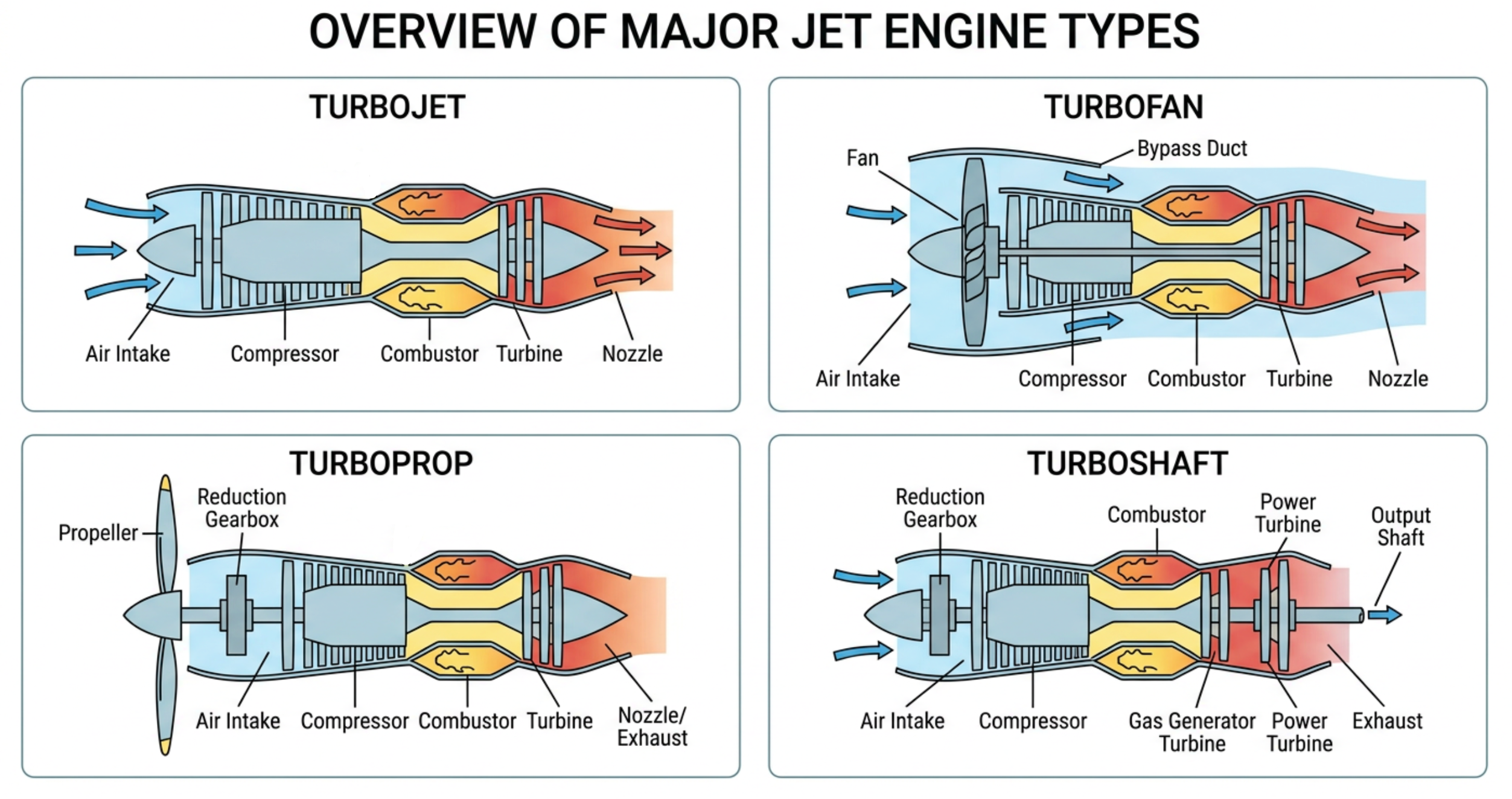
The common core: the gas generator
The gas generator — compressor, combustor and the turbine stage or stages that drive that compressor — is a machine whose only product is a stream of hot, high-pressure gas. On its own it produces no useful output at all; every joule the turbine extracts is fed straight back into the compressor. Everything downstream of the gas generator is the power section, and it exists to convert what is left in the gas into whatever form the aircraft needs.
| Type | What happens to the leftover gas energy | Propulsive device | Typical application | Rated in |
|---|---|---|---|---|
| Turbojet | All of it is expanded through the propelling nozzle as velocity | The jet itself | High-speed and supersonic aircraft; missiles; legacy transports | Thrust |
| Turbofan | Most is extracted by extra turbine stages to drive a ducted fan; the remainder leaves as core jet velocity | Ducted fan, plus a residual core jet | Commercial transports; business jets; modern combat aircraft (low bypass) | Thrust |
| Turboprop | Nearly all is extracted as shaft work through a reduction gearbox; a small residual jet remains | Propeller | Regional airliners, utility and military transports, trainers | SHP and ESHP |
| Turboshaft | Essentially all of it is extracted as shaft work; residual jet thrust is deliberately minimised | Rotor, or any external driven load | Helicopters; auxiliary power units; ground and marine power | Shaft power |
Turbojet
In a turbojet every kilogramme of air taken in passes through the core, and the entire propulsive output leaves through the propelling nozzle. Since the whole airflow is being given a large velocity increase, the jet velocity is very high and the specific thrust — thrust per unit of airflow — is the highest of the four types. That makes the engine compact in frontal area for the thrust it produces, which matters greatly on an aircraft designed for high speed, where nacelle drag is punishing.
The high jet velocity is also the turbojet's weakness at low speed and its strength at high speed. At subsonic cruise the exhaust is travelling far faster than the aircraft, so a great deal of kinetic energy is thrown away and the specific fuel consumption is poor. It also makes the engine extremely noisy: jet mixing noise rises with roughly the eighth power of jet velocity, so a modest reduction in exhaust speed produces a dramatic reduction in noise. But at very high flight speeds — approaching and beyond 800 mph — the aircraft's own velocity is approaching the exhaust velocity of a low-jet-speed engine, and only an engine whose jet is genuinely fast still has a useful velocity difference to exploit. That is why the turbojet remains the answer for the highest speed regimes, usually with reheat, while it has been displaced everywhere else.
Turbojets may be single-spool (one compressor, one turbine, one shaft) or twin-spool. Adding reheat — burning additional fuel in the jet pipe downstream of the turbine, where there is still plenty of unused oxygen — gives a large increase in thrust for a very large increase in fuel consumption, and requires a variable-area propelling nozzle so the extra volume of gas can be passed without changing the working conditions of the turbine.
Turbofan
A turbofan adds a large-diameter fan ahead of the core. Air leaving the fan divides: part enters the core compressor, and the rest — the bypass air — passes through the fan duct and straight out. The fan is mounted on the low-pressure shaft and is driven by the low-pressure turbine at the rear of the engine, through a shaft running concentrically inside the high-pressure shaft. This is a mechanical drive through metal, not an aerodynamic effect: the fan is not turned by air passing over it, and it is not turned by combustion gases striking it, and it is not driven by the accessory gearbox. The gases expand through the low-pressure turbine, that turbine turns the shaft, and the shaft turns the fan.
On a modern high-bypass engine the fan is doing most of the propulsive work — commonly something like three-quarters of the total thrust comes from the bypass stream, with the core jet providing the remainder. The design point of the whole engine follows from that: the low-pressure turbine has to be large enough and have enough stages to absorb the power the fan needs.
Two exhaust arrangements are in common use. In a separate-jet (short duct) installation the bypass air discharges from its own nozzle around the outside of the core, and the two streams mix in the open air. In a mixed-exhaust (long duct) installation the two streams are brought together inside the nacelle, usually through a lobed forced mixer, before leaving through a common nozzle; that recovers a small performance benefit and reduces noise, at the cost of a heavier duct. A geared turbofan places a reduction gearbox between the low-pressure turbine and the fan, so that the fan can turn slowly — as a large fan must, to keep its tip speed acceptable — while the low-pressure turbine turns several times faster, where it is efficient and needs fewer stages.
Turboprop
A turboprop uses the propeller as its propulsive device and the gas turbine purely as a source of shaft power. Because a propeller must turn far more slowly than any turbine, a reduction gearbox is always fitted, typically reducing the speed by a large factor and multiplying the torque correspondingly.
The energy split is heavily weighted towards the shaft: as a general figure, on the order of nine-tenths of the available gas energy is extracted by the turbines and delivered to the propeller, leaving roughly a tenth to leave the exhaust as a modest jet reaction. That residual jet is small but real, it does useful work whenever the aircraft is moving, and it is the reason a turboprop's total output is quoted as equivalent shaft horsepower rather than shaft horsepower alone. An answer that reverses this split — that the majority goes to jet reaction with the residue driving the propeller — describes no turboprop that has ever been built.
Two shaft arrangements exist. In a direct-coupled (fixed-shaft) turboprop the propeller reduction gearbox is driven from the same shaft as the compressor, so propeller and compressor speeds are permanently locked together. In a free-turbine turboprop a separate power turbine, mechanically independent of the gas generator, drives the gearbox.
The turboprop's ceiling is set by the propeller, not by the engine. As flight speed rises, the helical speed of the propeller blade tips — the vector sum of rotational and forward speed — approaches the speed of sound, and compressibility losses cut propeller efficiency sharply. That is what limits the type to the lower end of the speed range, and it is why the aircraft that cross that boundary switch to a ducted fan, where the duct and the fan's own pressure ratio hold the relative flow at the blades under control.
Turboshaft
A turboshaft is a gas turbine arranged to deliver essentially its entire output as shaft power to an external load — most commonly a helicopter transmission, but also an auxiliary power unit, a ground power set or a marine drive. The exhaust is deliberately arranged to leave at low velocity, since any residual jet thrust on a helicopter would be a nuisance rather than a benefit, and on a military helicopter the exhaust is often turned and mixed with cool air to reduce its infra-red signature.
Almost all helicopter turboshafts use a free turbine. The reason is a matter of operating requirements rather than efficiency. A helicopter rotor must be held at very nearly constant speed at all times, while the gas generator has to be free to accelerate and decelerate over a wide speed range as the pilot changes collective pitch. Locking the two together would make that impossible. With a free turbine, the gas generator runs at whatever speed the power demand requires and the power turbine turns with the rotor at its own governed speed, the two connected only by the stream of gas passing between them.
Free turbine and direct-coupled arrangements compared
| Aspect | Direct-coupled (fixed shaft) | Free turbine |
|---|---|---|
| Mechanical arrangement | Output drive taken from the same shaft that carries the compressor and its turbine | A separate power turbine with no mechanical connection to the gas generator shaft; the only link is the gas stream |
| Starting | The starter must turn the compressor and the load through the gearbox, so a higher starting torque is needed | The starter turns only the gas generator, so starting torque is much lower |
| Load at start | The propeller or rotor turns as soon as the engine turns | The propeller or rotor can be held stationary, for example by a rotor brake, while the core is running |
| Speed matching | Compressor and output speeds are locked in a fixed ratio; the compressor must run near its design speed whenever the load is being driven | Each rotating assembly finds its own best speed independently |
| Engine braking | Available — the load is mechanically tied to the compressor, so a windmilling propeller drives the core | None — there is no mechanical path from the load back to the gas generator |
| Overspeed risk | Loss of load cannot instantly overspeed the assembly, because the compressor remains as a load | Sudden loss of load can allow the power turbine to accelerate very rapidly, so an independent power-turbine overspeed protection system is essential |
| Typical use | Some turboprop installations | Virtually all helicopter turboshafts and many turboprops |
Whichever arrangement is used, the energy accounting in a free-turbine engine is worth stating plainly, because it is a favourite examination point: the gas generator's job is only to make the high-energy gas stream, and the bulk of the energy in that stream is then extracted by the free (power) turbine to drive the output shaft. It is not mostly consumed driving the gas generator, and it is not mostly expelled through the exhaust — the whole design intent is to convert as much of it as possible into shaft power.
Free-turbine overspeed. Because there is no mechanical connection between the power turbine and the gas generator, anything that suddenly removes the load — a sheared drive shaft, a decoupled gearbox, a propeller or rotor departing its mounting — leaves the power turbine with the full gas stream still passing through it and nothing to absorb the work. Acceleration can be extremely rapid, and a burst turbine disc is not containable. This is why free-turbine engines carry a dedicated overspeed protection system, usually acting independently of the normal fuel governing, and why its periodic functional test is not an optional item.
Matching the type to the flight regime
| Speed band (typical) | Best-suited type | Reason |
|---|---|---|
| Low subsonic, up to roughly Mach 0.5–0.6 | Turboprop | A propeller moves an enormous mass of air for a small velocity increase, giving the highest propulsive efficiency of all at low speed. Above this band, tip compressibility ends the advantage. |
| High subsonic, roughly Mach 0.75–0.9 | High-bypass turbofan | The bypass stream keeps the jet velocity close to the flight speed, which is where propulsive efficiency is best, while the duct keeps the fan blades working in controlled conditions. |
| Transonic and low supersonic | Low-bypass turbofan, usually with reheat | A higher jet velocity is needed to keep a useful velocity difference at these speeds, and reheat provides large thrust increases for short periods. |
| High supersonic | Turbojet | Only a very high jet velocity still exceeds the flight speed by a useful margin; ram compression in the intake also does an increasing share of the compression. |
How the speed question is usually asked. If an examination question gives you a flight speed of around 800 mph and asks which engine type would typically be used, it is testing the velocity-difference argument, not aircraft-specific knowledge. At that speed a high-bypass fan, whose exhaust leaves at only a little above the aircraft's own speed at cruise, would have almost no velocity difference left to produce net thrust. The engine that still works is the one with the high jet velocity: the turbojet.
Bypass Ratio
Bypass Ratio (BPR) = mass flow of bypass air ÷ mass flow through the core
\[ BPR = \frac{\dot{m}_{bypass}}{\dot{m}_{core}} \]
| Type | Typical BPR | Characteristics |
|---|---|---|
| Turbojet | 0 (no bypass) | All air through core. High jet velocity. Noisy. Efficient at very high speeds. |
| Low-bypass turbofan | 0.3 – 2:1 | Military fighters. Afterburner capable. Balance of speed and efficiency. |
| High-bypass turbofan | 5:1 – 12:1 | Modern airliners. Large fan moves enormous mass of air at moderate velocity. Very fuel-efficient, quiet. |
| Ultra-high-bypass | 12:1+ | Latest generation engines (geared turbofans). Maximum propulsive efficiency. |
Why high bypass is efficient: Propulsive efficiency is maximised when the jet exhaust velocity is only slightly faster than the aircraft speed. A high-bypass fan accelerates a large mass of air by a small amount — same thrust, less wasted kinetic energy, less noise.
Calculating and reading a bypass ratio
Worked example
An engine takes in a total of 350 kg/s at its design point. Of that, 50 kg/s passes through the core and the rest goes down the bypass duct.
Bypass flow \( = 350 - 50 = 300\ \text{kg/s} \)
\( BPR = 300 / 50 = 6 \), quoted as 6:1.
Read that back carefully: a bypass ratio of 6:1 does not mean six-tenths of the air bypasses the core. It means six kilogrammes bypass for every one that goes through, so six-sevenths — about 86% — of the total intake flow never sees the combustor at all.
A bypass ratio is quoted for a stated operating condition, usually cruise or sea-level static, because the split between the two streams shifts somewhat with flight condition and power setting. When comparing two engines, make sure the conditions match.
Propulsive efficiency, put into numbers
Propulsive (Froude) efficiency — the fraction of the energy given to the air that ends up as useful propulsive work:
\[ \eta_{p} = \frac{2 V_{0}}{V_{0} + V_{j}} = \frac{2}{1 + V_{j}/V_{0}} \]
where \( V_{0} \) is the flight speed and \( V_{j} \) the jet velocity. The expression is exactly 1 when \( V_{j} = V_{0} \) — but that produces no thrust at all — and exactly 0 when \( V_{0} = 0 \), which is why an engine on the brakes does no useful work no matter how much fuel it burns.
Worked example — the same thrust from two very different engines
Both aircraft are cruising at \( V_{0} = 240 \) m/s.
Turbojet, jet velocity 600 m/s: \( \eta_{p} = 2 \times 240 / (240 + 600) = 480/840 = 0.57 \), i.e. 57%. Velocity difference available for thrust: \( 600 - 240 = 360 \) m/s per kg/s of airflow.
High-bypass turbofan, effective jet velocity 320 m/s: \( \eta_{p} = 2 \times 240 / (240 + 320) = 480/560 = 0.86 \), i.e. 86%. Velocity difference available: \( 320 - 240 = 80 \) m/s per kg/s.
The turbofan converts a far higher share of the energy it puts into the air into useful work — but it gets only 80 N of thrust from each kg/s of airflow, against the turbojet's 360 N. To match the turbojet's thrust it must handle \( 360/80 = 4.5 \) times the mass flow. That factor of four and a half, in one number, is why the fan is so large.
What a large fan costs
Raising the bypass ratio is not free, and a complete answer has to give both sides of the ledger. The penalties are:
- Diameter, weight and drag. The nacelle grows with the fan. A larger nacelle has more wetted area and more external drag, and the structure to carry it is heavier. Beyond a point the installed drag and weight penalty begins to eat the fuel saving the cycle produced.
- Ground clearance and undercarriage. A larger fan on a low-wing aircraft either needs a longer, heavier undercarriage or a flattened nacelle and a pylon reposition — airframe consequences that are expensive on a re-engined design.
- Shaft speed mismatch. A big fan must turn slowly, because its tip speed is limited. The low-pressure turbine driving it is then forced to run slowly too, and a slow turbine is an inefficient turbine, so more low-pressure turbine stages are needed to absorb the same power. Adding a reduction gearbox solves the mismatch but adds a large, heavily loaded, oil-cooled component of its own.
- Containment and reverser mass. Fan blade-off containment structure and the thrust reverser both scale with fan diameter, and both are pure weight.
- Thrust lapse with forward speed. This is the aerodynamically important one. Because a high-bypass engine's jet velocity is only a little above the flight speed, the velocity difference — and therefore the net thrust — is eroded quickly as the aircraft accelerates. The worked example above shows the mechanism: an engine with 80 m/s of velocity difference has far less margin to lose than one with 360 m/s.
Which side dominates depends entirely on the flight speed. At the cruise speeds flown by commercial transports, the propulsive efficiency gain is large and the penalties are manageable, so the fuel saving wins decisively — which is why bypass ratios have climbed steadily for more than fifty years and continue to climb. Above roughly Mach 1.5, the argument inverts: a high-bypass engine's jet is simply not fast enough to produce useful net thrust against the ram drag at those speeds, so a low bypass ratio, or none at all, wins. There is no single "best" bypass ratio, only a best one for a stated design speed.
Bypass ratio, fan pressure ratio and specific thrust
Three design parameters move together, and recognising the pattern makes engine data far easier to interpret. As the bypass ratio rises, the fan pressure ratio falls: a bigger fan moving more air does not need to raise the pressure of that air by as much to produce the same thrust. Lower fan pressure ratio means a lower bypass jet velocity, which means lower specific thrust — less thrust per kilogramme per second of airflow — which is exactly what forces the engine to be physically larger. So high bypass ratio, low fan pressure ratio, low specific thrust, large diameter and low specific fuel consumption are all descriptions of the same design choice seen from different angles.
Cold stream and hot stream
The bypass air is universally called the cold stream and the core exhaust the hot stream. The terminology matters practically as well as descriptively: because on a high-bypass engine the great majority of the thrust is carried by the cold stream, a thrust reverser that acts on the cold stream alone recovers most of the available reverse effect while keeping the reverser structure away from turbine-exit gas temperatures. That is why the cascade-type cold-stream reverser described below is the standard fit on high-bypass engines, while hot-stream designs belong to engines with little or no bypass flow.
Bypass ratio is a ratio of mass flows. It is not a ratio of duct areas, not a ratio of thrusts, and not a percentage. An engine with a bypass ratio of 9:1 does not produce nine times more thrust from the fan than from the core — the thrust split is different from the mass split, because the two streams leave at different velocities. Read the definition in the formula box above literally and the arithmetic will come out right.
Engine Constructional Arrangement
| Section | Components | Function |
|---|---|---|
| Air intake | Nacelle inlet lip, intake duct | Delivers clean, uniform airflow to the compressor. Subsonic intakes are a simple divergent duct. Supersonic intakes use variable geometry (ramps/cones). |
| Compressor | Axial (rows of rotating blades + stator vanes) or centrifugal (impeller + diffuser) | Raises air pressure 10–50×. Axial: higher efficiency, many stages. Centrifugal: simpler, more robust, used in smaller engines. |
| Combustion section | Can-type, cannular (can-annular), or annular combustors, fuel nozzles, igniters | Burns fuel at constant pressure. Must mix fuel and air, sustain a stable flame at high airflow, and cool the liner to survive extreme temperatures. |
| Turbine section | Rows of stator (nozzle guide vanes) + rotor blades. HP turbine drives HP compressor; LP turbine drives LP compressor/fan. | Extracts energy from hot gas to drive the compressor (and fan in turbofans). Made of nickel superalloys, often single-crystal. Air-cooled blades. |
| Exhaust section | Exhaust cone, jet pipe, nozzle (convergent or convergent-divergent) | Accelerates remaining gas energy into thrust. Convergent nozzle for subsonic jets; C-D nozzle for supersonic applications. |
Air intake
The intake is the only part of the engine with no moving parts and no fuel burnt in it, and it is nonetheless one of the most performance-critical. Its job is to deliver air to the compressor face with the highest possible total pressure and with as little distortion across the face as it can manage. Total pressure lost in the intake can never be recovered — the compressor can only multiply the pressure it is given — so a percentage of total pressure lost in the duct translates almost directly into a loss of thrust for the same fuel flow. That is why intake ducts are kept short, smooth, free of steps and gaps, and why damage to an intake lip or acoustic lining is treated as a performance matter and not merely a cosmetic one.
Distortion is the second concern. If part of the compressor face receives air at a different pressure or angle from the rest — because of a crosswind on the ground, a high angle of attack, sideslip, or a damaged lip — each compressor blade passes alternately through good and poor air once per revolution. The blades in the distorted sector run at a higher incidence than the rest, and it is those blades that stall first. Intake distortion therefore reduces surge margin, and an engine that surges only in a crosswind or at high angle of attack is telling you where to look.
Other intake features an engineer meets in practice: hot-air anti-icing supplied from the compressor to the lip, because ice accreting on the lip both distorts the flow and can shed into the compressor as a solid slab; acoustic linings in the duct wall; drain holes; and the vortex dissipation arrangements fitted to some installations. Supersonic intakes are a different discipline altogether: they use variable ramps or a translating centre-body to position a system of shock waves so that the flow arrives at the compressor subsonically and with good pressure recovery, and at high Mach numbers the intake performs a large share of the total compression before the compressor sees the air at all.
Compressors
A compressor stage is one row of rotating blades followed by one row of fixed blades: one rotor plus one stator. That pairing is the unit of compression, and a multi-stage compressor is simply that unit repeated. The rotor does work on the air, raising both its velocity and its static pressure; the stator, which is a divergent passage and does no work, converts the added velocity into a further static pressure rise and straightens the flow so the next rotor row meets it at the right angle. Inlet guide vanes, where fitted, sit ahead of the first rotor to set the initial swirl and are not themselves part of a stage.
The pressure rise available from a single axial stage is small — of the order of 1.1:1 to 1.3:1 — because the stage is working against an adverse pressure gradient and the flow will separate if pushed harder. A single centrifugal stage, by contrast, can achieve something on the order of 5:1, because the impeller raises the pressure by centrifugal action as well as by diffusion, and centrifugal effects do not suffer the same separation limit.
Worked example — stage pressure ratios multiply, they do not add
A compressor of ten axial stages, each achieving 1.30:1:
\( 1.30^{10} = 13.8 \), so the overall pressure ratio is about 13.8:1 — not 13:1, and certainly not 10 × 1.3.
Add a further four stages at 1.25:1 apiece and the ratio becomes \( 13.8 \times 1.25^{4} = 13.8 \times 2.44 = 33.7 \), i.e. about 34:1. This multiplication is why an overall pressure ratio of 40:1 or more needs a great many stages, and why every fraction of a percent of stage efficiency is worth chasing.
Compressor pressure ratio is defined as delivery pressure divided by inlet pressure:
\[ r = \frac{P_{outlet}}{P_{inlet}} \]
It is an overall figure for the compressor as a whole, taken across it from front to back. It is not a measure of airflow, and it is not the ratio achieved by any one rotor row in isolation.
| Feature | Axial compressor | Centrifugal compressor |
|---|---|---|
| Pressure ratio per stage | Roughly 1.1:1 to 1.3:1 | Of the order of 5:1 |
| Stages needed for a high overall ratio | Many — ten to twenty is common | One or two |
| Why the efficiencies differ | Each stage turns and diffuses the flow only slightly, and the flow stays axial from front to back, so the losses per stage are small | The air is turned through a right angle, thrown outward at very high velocity and then decelerated through a large area change in the diffuser; each of those actions costs total pressure |
| Frontal area for a given mass flow | Small — the flow stays axial | Large — the flow is thrown radially outward |
| Robustness and tolerance of damage | Lower; thin aerofoils are vulnerable to FOD and erosion | Higher; the impeller is a thick, stiff component |
| Typical application | All large engines; the whole compression system of a transport engine | Small turboprops, turboshafts and APUs; also as the final stage of an axi-centrifugal compressor |
Several construction details follow from the physics. Axial blades are twisted from root to tip because blade speed increases with radius while the axial air velocity does not, so the angle at which the air meets the blade would otherwise change along the span. The annulus tapers from front to rear so that the rising density does not slow the axial velocity. Materials change through the compressor as the temperature climbs — titanium alloys in the cooler front stages, nickel-based alloys and steels at the rear where delivery temperatures can exceed 600 °C on a high-pressure-ratio engine. Modern front stages are frequently made as blisks, with blades and disc machined from a single forging, which removes the root fixings and their weight but means an individual blade can no longer simply be replaced.
Compressor stall and surge
Because the compressor is working against a rising pressure, its blades behave exactly like small aerofoils and will stall if the angle of attack becomes too great. Two related phenomena result. Rotating stall is a localised cell of stalled flow that propagates around the annulus at less than rotor speed; it may be sustained and may not be obvious except as vibration and a loss of efficiency. Surge is a complete breakdown of the flow, in which the pressure gradient briefly wins and the air in the compressor reverses direction. Surge announces itself with a loud bang, a rapid rise in exhaust gas temperature, a drop or hesitation in rotor speed, vibration, and sometimes visible flame from the intake or the tailpipe.
The causes are all variations on the same theme — the compressor is being asked for more pressure rise than it can deliver at that speed:
- Too rapid an increase in fuel flow, raising the turbine entry temperature and the back-pressure faster than the rotor can accelerate.
- Intake distortion from crosswind, sideslip, high angle of attack or damage.
- Deterioration: eroded or fouled aerofoils, opened tip clearances, worn seals. Deterioration moves the working line closer to the surge line, so an old engine has less margin than a new one.
- Faults in the handling system: a bleed valve that has failed closed at low speed, or variable stator vanes out of rig.
- Blade damage, contamination or ice accretion.
- Excessive customer bleed extraction from the high-pressure compressor, which reduces the flow available to the turbine and moves the working line up towards the surge line.
The countermeasures are all about matching the front and rear of the compressor at off-design speeds. At low rotational speed the overall pressure ratio is low, so the air arriving at the rear stages is much less dense than it is at the design point. A stage can only pass so much volume flow, and a given mass of low-density air occupies far more volume than the rear stages were sized to handle, so they cannot swallow the volume flow the front stages are delivering. Get the direction right, because it is a standing examination trap: high density raises a stage's capacity to swallow mass flow, and it is the low density at low speed that limits what the rear of the compressor can pass. The front stages back up against that restriction and are driven towards stall, so surplus air has to be spilled. That is the job of the variable bleed valves (also called handling bleed valves), and it fixes their operating logic: they are open during starting and at low power, spilling air from an intermediate stage into the bypass duct or overboard, and they close progressively as the engine accelerates and the compressor becomes matched. A worked check makes the direction unmistakable: at 20% N2 during a start, the valves are fully open; at take-off power they are shut.
Variable stator vanes attack the same problem from the other direction. At low speed they are held in a partly closed position, adding swirl in the direction of rotor rotation so that the following rotor blades see an acceptable angle of attack; as speed rises they are progressively opened towards their high-speed setting. Multiple spools are the third and most fundamental answer: splitting the compressor into two or three independent assemblies lets each run at the speed that suits it rather than forcing all stages onto one shaft.
Combustion section
The combustion chamber has to do something that at first sight looks impossible. Air leaves the compressor at a velocity far higher than the flame speed of kerosene, so a flame placed directly in that stream would simply be blown away. The chamber solves this by creating a sheltered, low-velocity, recirculating region. Air entering the flame tube through the snout and through swirl vanes around the fuel nozzle is given a strong rotational component, which sets up a toroidal vortex in the primary zone that continuously carries hot burning gas back upstream towards the incoming fuel spray. That recirculation is the flame holder, and everything else about the chamber is arranged around it.
The airflow through the chamber is divided deliberately, and the division is what makes the turbine survivable:
| Zone | What happens there | Why it exists |
|---|---|---|
| Primary zone | Fuel is atomised into recirculating air at close to the chemically correct (stoichiometric) mixture strength and burns. Local flame temperature here can approach 2,000 °C. | Complete, stable combustion requires something near stoichiometric conditions; nothing else will hold a flame reliably. |
| Secondary (intermediate) zone | Further air is admitted to complete the burning of any fuel and carbon monoxide leaving the primary zone. | The primary zone alone leaves unburnt products; the intermediate zone finishes the job before the gas is quenched. |
| Dilution zone | The air not consumed by combustion — around 60% of the chamber flow — is shared between this zone and the liner cooling film in the row below. The larger part of it enters through the dilution holes to bring the gas down to a temperature the turbine can withstand and to produce an acceptable temperature profile across the annulus. | Turbine entry temperature is set here, and so is the radial temperature distribution that determines blade and vane life. |
| Wall cooling film | The balance of that same 60% is admitted through rows of small holes along the flame tube wall to lay a protective film of relatively cool air between the metal and the flame. | The flame tube cannot survive direct radiation and contact from a 2,000 °C flame without being shielded. |
Two figures for "combustion air", and what each one counts. You will meet more than one number for the proportion of the chamber's airflow that takes part in combustion, and they are not competing claims — they draw the boundary in different places. The narrower figure counts only the air admitted to the primary zone, the air actually mixed with fuel at close to the chemically correct ratio, which is a fifth to a quarter of the chamber flow. The wider figure counts everything admitted before the dilution holes, that is the primary and secondary zones together, which comes to approximately 40% of the chamber flow, leaving about 60% for dilution and cooling. Both describe the same chamber. When an examination question asks what percentage of the air passing through the combustion section is burned, the figure it is looking for is 40%.
All of the air surrounding and cooling the flame tube is high-pressure compressor delivery air. It has to be: the air must be at a higher pressure than the gas inside the flame tube in order to flow inwards through the liner holes at all, and only compressor delivery air is. Low-pressure compressor air or fan air would simply not have the pressure to penetrate, so it cannot be used to cool a combustion chamber.
Three chamber layouts are in service:
| Type | Construction | Advantages | Disadvantages |
|---|---|---|---|
| Can (multiple) | Several complete flame tubes, each inside its own separate air casing, arranged around the engine. Interconnectors link them so the flame propagates at start and the pressures equalise. | Individual cans can be removed and replaced without disturbing the rest; easy to develop and test one can at a time. | Heavy and bulky; higher pressure loss; poor outlet temperature uniformity. |
| Cannular (can-annular) | Individual flame tubes, but all housed inside one common annular air casing. | A compromise: retains individual flame tubes while shortening and lightening the assembly. | Still more complex than an annular chamber; outlet profile less even. |
| Annular | A single continuous chamber. An inner and an outer flame tube skin form the annular combustion space, and these sit within inner and outer casings. The flame burns all the way round the annulus. | Shortest and lightest for a given output; lowest pressure loss; the most even outlet temperature distribution; the best surface-area-to-volume ratio for cooling. | Cannot be inspected or replaced piecemeal — access normally requires the engine to be split. |
Ignition is needed only to start the fire, not to keep it burning. Two high-energy igniter plugs, usually positioned in the primary zone, fire during the start sequence and during a relight; once the flame is established it is self-sustaining and the igniters are switched off. Continuous ignition is selected as a precaution in heavy rain, icing conditions, severe turbulence and during take-off and landing on some types, because a momentary interruption to the flame would otherwise become a flame-out.
The failure modes worth recognising are cracking and distortion of the flame tube from thermal cycling, burning and local hot spots where the cooling film has been disrupted, and carbon build-up on the fuel nozzles. That last one is deceptively serious: a carboned nozzle produces a distorted, streaky spray pattern instead of a fine cone, which puts a hot streak straight onto the nozzle guide vanes and turbine blades downstream and burns them locally. Borescope inspection of the chamber and the first-stage vanes is the standard means of finding all of this before it becomes a removal.
Turbine section
A turbine stage consists of a row of stationary nozzle guide vanes followed by a row of rotating turbine blades — in that order, NGV first. This is worth stating explicitly because it is the reverse of the compressor convention, where the rotor comes first and the stator follows. The reason is functional. In a compressor the rotor must do work on the air before there is any surplus velocity for a stator to diffuse. In a turbine the gas must first be accelerated and turned onto the correct angle before a rotor can extract work from it, and that is precisely what the nozzle guide vanes do. Inlet guide vanes belong to a compressor; a turbine stage never begins with them.
The nozzle guide vanes form a convergent passage, so static pressure falls and velocity rises through them. In normal operation the NGV throat is choked, which means the high-pressure NGV throat area effectively meters the mass flow through the core. It is one of the most critical dimensions in the engine, which is why NGV throat area is a controlled parameter at overhaul and why replacing vanes with the wrong classification changes the engine's whole running line.
Through the rotating blades the gas gives up work, so total pressure and total temperature both fall across a turbine — the exact opposite of what happens across a compressor. Turbine blades are twisted from root to tip for the same blade-speed reason as compressor blades, and the twist is usually accompanied by a change in the type of blading: closer to impulse at the root, where blade speed is low, and closer to reaction at the tip, where it is high.
The spool arrangement determines which turbine drives what:
- Single spool: one compressor and one turbine on one common shaft. They are mechanically joined, so the compressor and turbine speeds are always equal — there is no gearing and no separate assembly to make them differ.
- Twin spool: two independent rotating assemblies, that is two turbines on two shafts, one running concentrically inside the other. The high-pressure turbine — the first turbine stage or stages, immediately behind the combustor where the gas is hottest and at its highest energy — drives the high-pressure compressor. The low-pressure turbine, the later stages further downstream, drives the low-pressure compressor and the fan. Each spool is free to find its own speed.
- Triple spool: the same idea taken one step further, with an intermediate-pressure compressor and intermediate-pressure turbine forming a third independent assembly between the two.
Getting this the right way round matters. An arrangement in which the high-pressure turbine drove the low-pressure compressor, or in which one turbine drove both compressors, is not a twin-spool engine. And note that the term for an engine with two independent rotating systems is precisely twin-spool — not "compound", which describes something else entirely, and not "complex".
Optimum turbine speed is defined as the rotational speed at which the turbine works most efficiently: the speed at which the ratio of blade speed to gas velocity gives the best compromise between the work extracted and the losses incurred. It is a point of best efficiency, not a fixed percentage of maximum engine rpm. This definition is the root of several design decisions elsewhere in the engine, because the turbine's optimum speed is usually much higher than the optimum speed of the fan or propeller it has to drive — hence multiple spools, hence reduction gearboxes.
Materials and cooling. Turbine blades and vanes are made from nickel-based superalloys, cast rather than forged, and increasingly cast as directionally solidified or single crystal components. The purpose of removing grain boundaries is specific: grain boundaries transverse to the load are the preferred path for creep at high temperature, so a blade with no transverse boundaries — or none at all — survives a higher temperature for longer. On top of the alloy goes a ceramic thermal barrier coating, and inside the blade is a network of cooling passages fed with high-pressure compressor air, using internal convection, impingement onto the hottest internal surfaces, and film cooling through rows of small holes that lay a protective layer of cooler air over the outer surface. Taken together, these allow the gas entering the turbine to be hotter than the melting point of the blade alloy. The cooling air is a real cycle penalty — it was compressed at full cost and then largely bypassed the combustor — and it is spent anyway because raising turbine entry temperature is worth more.
Blades are attached to the disc by a fir-tree root, deliberately a slightly loose fit when cold so that the blade can be assembled and so that differential expansion is accommodated; centrifugal load and thermal growth take up the clearance in operation. Blade tips may be shrouded, which reduces tip leakage and provides damping through the interlocking shrouds, or unshrouded to save weight at the highest temperatures. Tip clearance itself is a first-order efficiency item — gas leaking over the tip does no work — and many engines control it actively by spraying fan or compressor air onto the turbine casing at cruise: cooling the casing shrinks it, which closes the tip clearance and raises efficiency.
The characteristic turbine failure modes are creep, which is the slow permanent extension of a blade under centrifugal load at high temperature; thermal fatigue cracking from repeated start-stop cycles; oxidation and sulphidation attack of the surface; tip rubs; and blocked cooling passages, which cause rapid local burning. Creep is cumulative and irreversible — a blade that has crept does not recover on cooling — which is why turbine blade growth is a measured, life-limited parameter and why exceeding a temperature limit even briefly is recorded against the engine. Turbine and compressor discs are separately life-limited on cycles rather than hours, because their limiting mechanism is low-cycle fatigue driven by the number of times the engine has been started and taken to power.
Exhaust section
Gas leaves the turbine with a good deal of swirl and at a velocity that is too high to be useful. The exhaust unit therefore begins with a divergent passage, formed between the outer jet pipe and the exhaust cone, with radial struts that also serve to straighten the swirl. Slowing the gas here recovers static pressure and reduces friction losses before the propelling nozzle does the final acceleration. The exhaust cone also prevents the gas from flowing across the flat rear face of the turbine disc, which would cause severe turbulence.
The propelling nozzle is the smallest cross-sectional area in the exhaust system, and it is the component that sets the back-pressure on the turbine. Its area is therefore a critical matching dimension: reducing the nozzle area at a given fuel flow raises the pressure and temperature in the jet pipe and alters the running line of the whole engine. On subsonic engines the nozzle is a fixed convergent duct. Supersonic engines, and any engine with reheat, use a convergent-divergent nozzle with variable geometry, so that the nozzle can be opened to pass the greatly increased volume of gas when reheat is selected without disturbing the turbine.
As explained above, once the nozzle pressure ratio exceeds the critical value the nozzle chokes and produces pressure thrust in addition to momentum thrust. Noise treatment lives here too: the serrated trailing edges (chevrons) seen on modern nacelles, and the lobed forced mixers used inside long-duct nacelles, both work by promoting a gentler, more gradual mixing of the exhaust with the surrounding air, which reduces the intensity of the shear that generates jet noise.
Shafts, spools and how the sections are held together
The low-pressure shaft runs the full length of the engine inside the hollow high-pressure shaft, which is short and stiff. This concentric arrangement is what allows the two assemblies to run at completely different speeds while occupying the same axis. Some designs run their spools in opposite directions, which reduces the net gyroscopic moment on the aircraft and can improve the aerodynamics at the turbine interduct. Each spool is supported on its own bearings, which are dealt with in the final section of this note.
Modular construction and maintainability
Modular construction means that the engine is designed and built as a set of self-contained major assemblies — typically a fan module, compressor modules, a combustor and high-pressure turbine module, a low-pressure turbine module and an accessory drive module — each individually balanced and each interchangeable with another of the same standard. The purpose is that a defective major assembly can be removed and replaced without stripping the whole engine, so an engine can be repaired in a matter of shifts rather than weeks, often without returning it to the manufacturer.
Two common misreadings are worth heading off. Modular construction does not mean that all engines share a specific component layout, and it does not refer to any particular technique of assembly. It is a statement about how the engine is divided for maintenance, nothing more. Alongside it sit the other maintainability features an engineer meets daily: borescope ports at defined stations so the gas path can be inspected without disassembly; on-condition maintenance driven by trend monitoring rather than fixed overhaul intervals; and the quick engine change (QEC) build-up, which keeps as much of the installation hardware as possible with the airframe.
Direction of change through the engine — the summary table
If you learn one table in this section, learn this one. Almost every incorrect answer about gas turbine behaviour is a correct mechanism with one of these arrows reversed.
| Section | Static pressure | Temperature | Gas velocity |
|---|---|---|---|
| Intake (in flight, subsonic) | Rises | Rises slightly | Falls — the duct is a divergent diffuser |
| Compressor | Rises — substantially, by the overall pressure ratio | Rises — compression heats the air, so both go the same way | Axial velocity held roughly constant by the tapering annulus |
| Combustion chamber | Nominally constant; a small loss in practice | Rises very sharply | Rises — the gas expands at constant pressure, so it must speed up |
| Turbine | Falls — work is being extracted | Falls — again both go the same way, but downwards | Rises through the nozzle guide vanes, then falls across the rotor as work is taken out |
| Exhaust unit / jet pipe | Rises slightly — a divergent passage | Static temperature rises slightly as the flow slows; total temperature is unchanged | Falls |
| Propelling nozzle (convergent, subsonic) | Falls | Falls | Rises — this is where the remaining pressure energy becomes thrust |
General Engine Requirements and Performance Parameters
Everything described so far explains how a gas turbine works. This section deals with what it is required to achieve, and with the small set of numbers by which its achievement is measured. These are the parameters that appear on a data plate, in a flight manual, on a trend-monitoring plot and in an examination question, and an engineer needs to be able to say not only what each one is but which way it moves when a condition changes.
What a certificated engine has to deliver
An aircraft engine is type-certificated against a dedicated code — in the European system, the Certification Specifications for Engines, CS-E — and the airframe installation is certificated separately under the relevant aircraft code. The requirements the engine has to meet fall into a small number of families:
- Thrust or power for its weight and size. Everything installed on an aircraft is weighed, and an engine's thrust-to-weight ratio and frontal area feed directly into aircraft performance and drag.
- Fuel economy. Over the life of a transport aircraft, fuel dominates direct operating cost, so specific fuel consumption is usually the single most heavily traded parameter in the design.
- Reliability and dispatchability. An engine is judged by in-flight shutdown rate and by how rarely it prevents an aircraft leaving the gate. On extended-range twin operations these figures are the licence to operate.
- Life on wing. How long the engine stays installed between shop visits, which in modern practice is governed by deterioration and life-limited parts rather than by a fixed overhaul interval.
- Structural integrity and containment. A failed blade must be contained within the casing; rotor discs must not burst, which is why they are life-limited on cycles; overspeed and overtemperature cases must be survivable or protected against.
- Handling and surge margin. The engine must accelerate and decelerate on demand across the whole envelope without surging or flaming out, and it must do so with distorted intake flow and with bleed air being taken off.
- Starting and relight. It must start reliably on the ground over a wide temperature range, and it must relight in flight within a defined altitude and airspeed envelope.
- Ingestion tolerance. Birds, hail, heavy rain, ice shed from the intake or airframe, sand and volcanic dust are all certification cases, and the engine must either continue running or fail safely.
- Noise and emissions. Both are subject to international standards, and both have become primary design drivers rather than afterthoughts.
- Maintainability. Modular build, borescope access, line-replaceable accessories, on-condition monitoring — discussed in the previous section — are certification and commercial requirements in their own right.
Thrust and its ratings
An engine does not have one thrust; it has a set of ratings, each with its own limits and its own permitted duration:
- Take-off thrust — the highest rating, time-limited (commonly five minutes, extended in the event of an engine failure on a twin).
- Maximum continuous thrust — the highest rating with no time limit, reserved for abnormal situations such as engine-out operation.
- Maximum climb and maximum cruise — the normal in-service ratings, set well below take-off thrust.
Derated and reduced-thrust take-offs matter to the engineer as much as to the crew. Where runway length and obstacle clearance allow, the crew may take off at less than full rated thrust, either by selecting a lower published derate or by using an assumed (flexible) temperature. The purpose is engine life: reducing take-off thrust lowers the turbine entry temperature, and because the rate of hot-section deterioration climbs very steeply with temperature, even a modest reduction produces a disproportionate extension of on-wing life. The direction is worth stating plainly — less take-off thrust means a lower operating temperature and therefore a longer life, which is why operators use it whenever performance permits.
Flat rating is the other rating concept an engineer meets constantly. An engine is capable of far more thrust on a cold day than on a hot one, because the air is denser. Rather than let the crew have that extra thrust — which the airframe and the engine structure would have to be designed to absorb — the engine is flat rated: its control system holds the rated thrust constant as ambient temperature varies, up to a stated flat-rating temperature, commonly in the region of ISA + 15 °C. Below that temperature the engine is deliberately restrained and produces exactly its rated thrust. Above it, a temperature limit binds first, and available thrust falls as ambient temperature rises further. This is why take-off performance charts show a flat region followed by a declining one, and why a hot-day departure can become performance-limited quite suddenly.
Thrust cannot be measured directly in flight, so it is set by a parameter that varies with it. Depending on the engine, the crew sets thrust either on engine pressure ratio (EPR) — the ratio of turbine discharge total pressure to engine inlet total pressure — or on fan speed (N1). Both are valid thrust-setting parameters; which one a given engine uses is a design decision, and the flight manual will say.
What changes the thrust
| Change | Effect on thrust | Mechanism — and the direction of it |
|---|---|---|
| Ambient temperature rises | Thrust falls (above the flat-rating temperature) | Hotter air is less dense, so at the same rotational speed the engine ingests less mass per second. Thrust is proportional to mass flow, so it falls with it. |
| Altitude increases | Thrust falls | Density falls with altitude, so mass flow and thrust fall. Up to the tropopause the falling temperature partly offsets the falling pressure; above the tropopause the temperature stops falling, so density — and thrust — drop away more steeply with height. |
| Forward speed increases | Net thrust falls through the low and middle subsonic range, then recovers at high Mach | Two competing effects: ram drag grows directly with airspeed and reduces net thrust, while ram compression raises intake pressure, mass flow and jet velocity and increases gross thrust. The first dominates at moderate speed; the second, which grows with the square of speed, eventually takes over. |
| Humidity increases | Negligible effect | Unlike a piston engine, where water vapour displaces oxygen in a fixed cylinder volume and measurably reduces power, a gas turbine's continuous flow and large excess of air make the effect small enough to ignore in practice. |
| Rotational speed increases | Thrust rises, and rises disproportionately fast at the top of the range | Raising rpm increases both the mass flow and the pressure ratio, and the two effects compound. Most of the engine's thrust is produced in the upper part of its speed range, which is why a small percentage change in N1 near take-off power is a large change in thrust. |
| Bleed air or shaft power is extracted | Thrust falls | Air taken from the compressor for air conditioning, anti-icing or pressurisation has been compressed at full cost and then removed before it can do work in the turbine; shaft power taken through the accessory gearbox is likewise unavailable for propulsion. |
Specific fuel consumption
Thrust specific fuel consumption (TSFC) for a thrust-producing engine:
\[ TSFC = \frac{\dot{m}_{f}}{F_{n}} \]
Fuel flow divided by net thrust. Common units are kg per kN per hour, or lb of fuel per lb of thrust per hour.
For a shaft engine the equivalent is specific fuel consumption based on power: fuel flow divided by shaft power, in kg per kW per hour or lb per shp per hour.
SFC is a cost, not a score — lower is better. It measures how much fuel you must burn to buy one unit of thrust for one hour, so the smaller the number, the better the engine. Every improvement in thermal or propulsive efficiency lowers SFC. Raising the bypass ratio at subsonic cruise lowers SFC. Raising the overall pressure ratio lowers SFC. If you find yourself writing that an engine has become more efficient and its SFC has therefore increased, the sign is the wrong way round.
Worked example — what a few percent of SFC is worth
An engine holding 22 kN of cruise thrust on a fuel flow of 1,150 kg/h:
\( TSFC = 1150 / 22 = 52.3\ \text{kg per kN per hour} \).
A design improvement lowers the SFC by 5%, to 49.7 kg/kN/h. At the same 22 kN of thrust the fuel flow becomes \( 49.7 \times 22 = 1\,093\ \text{kg/h} \), a saving of 57 kg per hour per engine.
Over a ten-hour sector on a twin, that is \( 57 \times 10 \times 2 = 1\,140\ \text{kg} \) of fuel — and, because the aircraft no longer has to carry that fuel, a further small saving on top. A five percent SFC improvement is a very large commercial result, which is the reason engine manufacturers will accept significant weight and complexity penalties to obtain one.
The three efficiencies, and how they connect to SFC
Thermal efficiency — how much of the fuel's heat the core turns into mechanical work. Raised chiefly by increasing overall pressure ratio.
Propulsive efficiency — how much of that work ends up moving the aircraft rather than stirring up the wake:
\[ \eta_{p} = \frac{2}{1 + V_{j}/V_{0}} \]
Overall efficiency is the product of the two:
\[ \eta_{o} = \eta_{th} \times \eta_{p} \]
and specific fuel consumption follows directly from it:
\[ \frac{\dot{m}_{f}}{F_{n}} = \frac{V_{0}}{\eta_{o} \times LHV} \]
where \( LHV \) is the fuel's lower calorific value. At a given flight speed, SFC is inversely proportional to overall efficiency — the formal statement of "lower is better".
The two ways of improving an engine are therefore quite distinct, and they are pursued by different parts of the design. Thermal efficiency is improved by working the core harder: higher pressure ratio, higher turbine entry temperature, better component efficiencies, less cooling air for the same temperature. Propulsive efficiency is improved by moving more air more slowly: higher bypass ratio, lower fan pressure ratio. Modern engines pursue both at once, which is why they have both a very high overall pressure ratio and a very large fan.
Limits, indications and condition monitoring
The parameters the engineer works with day to day are the ones that keep the engine inside its certificated envelope:
- Rotor speeds (N1, N2 and where fitted N3) — each with a maximum, and each an indication of the health of its own spool.
- Exhaust gas temperature (EGT, or ITT/TGT depending on where it is measured) — the most closely watched limit on any gas turbine, because it is the proxy for turbine entry temperature, which cannot be measured directly.
- Fuel flow — the controlled variable, and a sensitive indicator of deterioration when compared against thrust.
- Oil pressure, oil temperature, oil quantity and vibration — the mechanical health group.
Power on a gas turbine is adjusted by one thing and one thing only: fuel flow. The thrust lever does not open an air valve. Increasing fuel flow raises the gas temperature and energy through the turbine, the turbine produces more work, the spool accelerates, and the compressor consequently draws in more air. The increase in airflow is therefore a result of the change in fuel flow, not something the crew commands separately.
EGT margin is the single most useful health parameter on a modern engine. It is the difference between the EGT the engine actually reaches at a reference take-off condition and the certificated limit. A new engine has a comfortable margin. As it deteriorates — tip clearances open, aerofoils erode and become fouled, seals wear, cooling holes partially block — it becomes less efficient, so it must run hotter to produce the same thrust, and the margin falls. When the margin approaches zero the engine can no longer achieve its rated thrust on a hot day, and that, rather than any single failure, is what most often drives a shop visit. Trend monitoring of EGT margin, fuel flow and rotor speeds against a reference model is what turns this into a planned removal rather than a delay.
An overtemperature is an event, not a reading. Turbine limits are set by the creep and oxidation behaviour of the hot-section materials, and creep damage is cumulative and permanent. An exceedance therefore has to be recorded against the engine with its magnitude and duration, and the maintenance manual will prescribe the inspection — typically a hot-section borescope, sometimes a module removal — that follows. It cannot be dismissed on the grounds that the engine subsequently ran normally, because a crept blade runs perfectly normally right up until it does not.
Thrust Reversers
Redirect engine exhaust forward to decelerate the aircraft on the ground after landing. Types:
| Type | Mechanism | Typical Use |
|---|---|---|
| Cascade (cold stream) | Translating cowl slides aft, exposing cascade vanes that redirect bypass air forward | High-bypass turbofans (most common) |
| Clamshell/bucket | Two doors (buckets) swing into the exhaust stream, deflecting it forward and outward | Low-bypass engines, older designs |
| Blocker door | Doors block the fan duct and deflect air through openings in the nacelle | Some high-bypass turbofans |
What a reverser actually does to the flow
The name is misleading and the misunderstanding it causes is worth clearing up first. A thrust reverser does not reverse the direction of the gas flowing through the engine core. Air still enters at the front, is still compressed, burned and expanded in the normal direction, and the core still runs exactly as it does in forward thrust. What the reverser does is intercept the efflux after it has been produced — on a high-bypass engine, overwhelmingly the bypass efflux — and redirect it so that it leaves with a large forward-pointing component. The reaction to that forward-moving mass of air is a rearward force on the aircraft, and that is what decelerates it.
Note "component", not "direction". The redirected air is turned forward and outward at an angle, never straight ahead: it has to clear the wing, the fuselage and the ground, and it must not be re-ingested by its own engine. Because the turning is incomplete and the redirected flow is aerodynamically untidy, the rearward force obtained is only a fraction of the forward thrust the same power setting would produce — commonly quoted as being in the region of 40 to 50%.
Cold stream and hot stream reversers
On a high-bypass turbofan the great majority of the thrust is carried by the cold bypass stream. Reversing that stream alone therefore recovers most of the available reverse effect, and it does so with a mechanism that never sees turbine-exit gas temperatures — a large saving in weight, cost and complexity. That is why the cascade type is the standard fit on modern transports and why the core exhaust on such an installation is usually left to continue rearward, unreversed, throughout the reverse selection.
Engines with little or no bypass flow have no cold stream worth reversing, so their reversers must act on the hot exhaust. Clamshell or bucket doors, swinging into the efflux behind the propelling nozzle, are the classic solution, and they have to be built from materials and with clearances appropriate to exhaust gas temperature.
How a cascade reverser operates
The mechanism of the common cold-stream reverser repays understanding, because most reverser defects are mechanical:
- The rear portion of the nacelle is a translating sleeve running on tracks. In the stowed position it forms the smooth outer line of the nacelle and covers the cascade vanes completely.
- On selection, actuators — pneumatic, hydraulic or electric depending on the type — drive the sleeve aft, uncovering a ring of fixed cascade vanes that are shaped to turn the air forward and outward.
- Blocker doors, hinged inside the sleeve and connected to the fixed inner structure by drag links, are pulled across the bypass duct as the sleeve translates. With the duct blocked and the cascades uncovered, the fan air has nowhere to go but out through the cascades.
- Actuators are usually tied together by flexible synchronising shafts so the sleeve cannot translate unevenly and jam.
Selection, interlocks and indication
Reverse is selected in a defined sequence that is protected by interlocks, and the first of those interlocks is the position of the thrust lever. Reverse thrust can only be selected with the thrust lever at the idle stop — that is, closed. Only then can the reverse levers be raised to command deployment, and only once deployment is confirmed can reverse power be applied. The purpose is obvious once stated: deploying a reverser with the engine at high forward power would subject the structure to loads it is not designed for and would produce a violent and unpredictable change in the aircraft's behaviour. Additional interlocks commonly include air/ground logic and radio altimeter or wheel-speed inputs, so that deployment is physically inhibited in flight.
The crew's confirmation that the reversers have actually deployed is a sequence of lights, supported by messages on the engine display system. A typical arrangement gives one indication as the reverser unlocks, another while it is in transit, and a third when it reaches the fully deployed position, so the crew can see each step of the sequence. What the crew does not rely on is the physical sensation of deceleration or an audible warning — deceleration is felt from the wheel brakes as well, and a reverser can be unlocked without being deployed. Positive position indication is the only acceptable confirmation.
Inadvertent deployment is a catastrophic failure case. A reverser deploying in flight, particularly asymmetrically, produces an immediate and severe loss of thrust on one side combined with a large disturbance to the wing's airflow, and it has caused hull losses. That is why certification requires multiple independent locks — the actuators' own locks plus at least one further, independent locking system — why auto-restow logic is fitted, and why reverser lock rigging, functional checks and deactivation procedures are among the most tightly controlled tasks in the maintenance manual. A reverser deactivated under the minimum equipment list must be secured stowed and locked in accordance with the approved procedure, not merely selected off.
Operational and maintenance considerations
- Stowing speed. Reversers are stowed before the aircraft slows below a speed specified for the type, typically somewhere in the region of 60 to 80 kt. Below that speed the reversed efflux can be re-ingested by the engine, which raises intake temperature and can cause surge, and it can also lift debris from the runway into the intakes.
- Where reverse actually earns its keep. On a long, dry runway the wheel brakes do most of the stopping and reverse contributes comparatively little. Its value rises sharply on a wet or contaminated runway, where the tyre-to-surface friction available to the brakes is poor but the reverser's effectiveness is unaffected by the surface, and in reducing brake energy absorption and brake wear on every landing.
- Reverse idle and maximum reverse. Most operators use reverse idle as the normal case and reserve maximum reverse for short, contaminated or otherwise demanding landings, partly for noise and partly because high reverse power at low speed aggravates re-ingestion.
- Inspection points. Cascade vane erosion and cracking; blocker door hinges, seals and drag link wear; translating sleeve tracks, rollers and seals; actuator and synchronising shaft condition; lock function; and any evidence of hydraulic or pneumatic leakage in the actuation supply. Reverser rigging is a controlled task, because an out-of-rig reverser can produce asymmetric drag or fail to reach a locked position.
Lubricants, Fuels, Lubrication Systems and Fuel Systems
Two fluids circulate through every gas turbine, and neither of them is doing only the job its name suggests. The oil lubricates, but its dominant duty is to carry heat away from bearings and gears that no airflow can reach. The fuel provides the energy, but it is also the engine's principal heat sink and the lubricant for its own high-pressure pump. Understanding the second job of each fluid explains most of what looks arbitrary about the two systems.
What a turbine lubricant has to do
- Lubricate — reduce friction and wear at bearings, gear teeth, splines and seals.
- Cool — this is the dominant duty. A bearing chamber sits inside a hot engine, receives heat conducted along the shafts and generated by the bearing itself, and has no cooling airflow of its own. The oil carries that heat away to an oil cooler, and the quantity of oil circulated is set by the cooling requirement, not by the lubrication requirement.
- Clean — carry wear debris away from the contact surfaces to the filters and magnetic chip detectors, where it can be found.
- Protect — prevent corrosion of parked or stored components.
- Damp — provide the squeeze-film damping that controls shaft vibration at bearing supports.
Turbine oils are synthetic ester-based products, not mineral oils. Mineral oils cannot survive the bulk and local temperatures in a turbine bearing chamber: they oxidise, break down and form carbon deposits (coking) in the hottest passages, and coke blocks oil jets and vent lines. Two broad classes are in use, usually described by their viscosity: a Type I class of about 3 centistokes and the more widely used Type II class of about 5 centistokes, covered respectively by the long-standing specifications MIL-PRF-7808 and MIL-PRF-23699, with higher-thermal-stability variants of the latter also available. Which one an engine takes is stated by the manufacturer, and it is not a matter of preference.
Two practical points that catch people out.
Do not mix oils. Different types, and in some cases different brands of the same type, may not be intermixed without approval. The maintenance manual states which products are approved and what the mixing rules are; a mixture outside those rules can produce sludge, seal swell or reduced thermal stability.
Turbine oils are a health hazard. The ester base and the additive package can be absorbed through the skin and are irritant to eyes and airways, and oil mist is a respiratory hazard. Wear the gloves specified in the safety data sheet, avoid skin contact, and treat contaminated clothing accordingly.
Check the level in the specified window. Oil migrates from the tank into the bearing chambers and gearbox after shutdown. The manual specifies a period after shutdown within which the oil level check is valid; a check made outside that window can read low when the tank is full or full when it is low, and either error can put an aircraft into service in the wrong condition.
The lubrication system is three systems
A gas turbine lubrication system is conventionally described as three sub-systems, and questions on this point expect that number:
| Sub-system | What it does | Principal components |
|---|---|---|
| Pressure (feed) system | Delivers oil from the tank to every bearing chamber and to the gearboxes at a controlled pressure and flow. | Oil tank with deaerator, pressure pump, pressure filter with an impending-bypass indicator and a bypass valve, pressure relief or regulating valve, oil cooler, distribution pipework, oil jets and last-chance filters. |
| Scavenge system | Collects the oil that has done its work in each chamber and returns it to the tank. | One scavenge pump per bearing chamber and one for each gearbox, scavenge filters, magnetic chip detectors, scavenge return line and deaerator. |
| Breather (vent) system | Controls the internal air pressures, venting the air that leaks into the chambers past the seals so the chambers do not pressurise. | Vent pipework from each chamber, a centrifugal breather (rotating deoiler) in the gearbox, and an overboard or exhaust-duct vent. |
Pressure system detail, and the two system types
The oil tank is deliberately larger than the oil it holds, both to allow for expansion and to give the returning aerated oil somewhere to separate. A deaerator at the scavenge return spins the froth so the air can be released, because oil full of bubbles neither lubricates nor cools properly and would give a false quantity indication.
Two arrangements govern the delivered pressure, and the distinction is a standard examination point:
- Pressure relief valve system. A relief valve set to a chosen pressure spills surplus oil back to the tank or to the pump inlet, so the delivered pressure is held at approximately that constant value once the engine is above the speed at which the pump can supply more than the engine needs.
- Full-flow system. There is no relief valve holding a set pressure in normal running; the whole of the pump's output is delivered to the engine. Because a positive-displacement pump delivers in proportion to its speed, the resulting oil pressure varies with engine speed and therefore with the throttle setting rather than sitting at a single fixed value. A full-flow system's oil pressure indication is expected to rise and fall as the power is changed, and it is read against a schedule rather than against one number.
Filtration is arranged in layers. A main pressure filter takes out the bulk of the contamination and carries a differential-pressure indicator that pops when the element is approaching bypass, so a clogging filter is found before it starts passing unfiltered oil. Downstream of it, small last-chance filters sit immediately upstream of the oil jets, whose orifices are small enough to be blocked by a single particle.
Scavenge system detail
Oil is not returned by gravity — an engine has no consistent "down" and the chambers are pressurised — so each sump has its own scavenge pump, all driven from the accessory gearbox. The total capacity of the scavenge pumps is deliberately made greater than the delivery of the pressure pump. The reason is that scavenged oil has been thrown about at high speed inside the chamber and is heavily aerated, so it occupies considerably more volume than the same mass of oil did on the way in. A scavenge system sized to the pressure pump's volume would flood the chambers.
Magnetic chip detectors in the scavenge lines are the primary early warning of internal mechanical distress, and their position matters: a detector in one chamber's scavenge line implicates that chamber's bearings, which is a great deal more useful than a single detector in the common return.
Breather system detail
Bearing chambers are sealed with air, not with oil-tight seals, and that air has to go somewhere. Compressor air at a higher pressure than the chamber leaks inwards past the labyrinth seals, which is exactly what stops oil leaking outwards. That inward leakage would steadily pressurise the chamber, and a pressurised chamber would force oil past its own seals into the gas path. The breather system vents the chambers to keep their internal pressure below the sealing air pressure, and a centrifugal breather in the gearbox — a rotating drum that flings the oil droplets outward and lets clean air pass through the middle — recovers the oil from the vent air before that air is discharged overboard or into the exhaust.
Cooling the oil
Most engines cool the oil with the fuel, in a fuel-cooled oil cooler, and the direction of the exchange is worth stating explicitly: the oil gives heat to the fuel. The oil is cooled, which is the primary purpose, and the fuel is warmed, which is a valuable secondary benefit because warm fuel is far less likely to precipitate ice crystals in the fuel filter. Some installations add an air-cooled oil cooler in the bypass duct, particularly where the fuel flow at low power is not sufficient to absorb the heat load.
Indications and condition monitoring
- Oil pressure and a separate low oil pressure warning; oil temperature; oil quantity.
- Filter impending-bypass indication — a rising differential pressure across the filter means the element is loading up with contamination.
- Chip detector indication, either as a warning in the flight deck or as an item examined at maintenance.
- Oil consumption trend — recorded uplift per flight hour, one of the most reliable long-term indicators of seal condition.
- Spectrometric oil analysis, where used, which identifies the metals present in the oil in very small quantities and can point to which component is wearing.
Turbine fuels
| Grade | Type | Freeze point (max) | Flash point (min) | Notes |
|---|---|---|---|---|
| Jet A-1 | Kerosene | −47 °C | 38 °C | The international civil standard, available worldwide. |
| Jet A | Kerosene | −40 °C | 38 °C | Used chiefly in the United States domestic market. |
| Jet B | Wide-cut (kerosene/gasoline blend) | −50 °C | Much lower — the fuel is volatile | Cold-climate and some military use. Its volatility makes it easier to start and relight in extreme cold but significantly increases the fire and handling risk, so it is not used in normal civil operations. |
| JP-8 | Kerosene | As Jet A-1 | As Jet A-1 | Military equivalent of Jet A-1, distinguished by its military additive package. |
| JP-5 | High-flash kerosene | −46 °C | 60 °C | The deliberately high flash point is for shipboard storage, where a fuel that gives off flammable vapour at ordinary temperatures would be unacceptable. |
The properties that matter operationally are:
- Calorific value — approximately 43 MJ/kg for all the kerosene grades. This is what sets fuel flow for a given power.
- Density — roughly 0.78 to 0.84 kg per litre at 15 °C and falling as temperature rises, which is why an uplift measured in litres must be converted with the actual density, and why fuel is loaded and planned by mass rather than volume.
- Freeze point — not the temperature at which the fuel solidifies, but the temperature at which wax crystals begin to appear and can block filters. On a long, high-altitude sector the fuel in the tanks cold-soaks towards ambient, and fuel temperature is a monitored parameter for that reason.
- Volatility and flash point — a safety property. A kerosene with a flash point of 38 °C does not produce an ignitable vapour at ordinary ambient temperatures; a wide-cut fuel does.
- Viscosity at low temperature — thick fuel atomises badly, which affects starting and relight.
- Thermal stability — the fuel is used as a heat sink, so it must not break down and lay down deposits in heat exchangers, filters and burner passages.
- Lubricity — the high-pressure pump and the metering unit are lubricated by the fuel passing through them, so a fuel with poor lubricity causes pump wear.
- Electrical conductivity — kerosene flowing through pipes and filters generates static, so conductivity is controlled to let the charge relax safely.
The additive package normally includes a fuel system icing inhibitor (di-ethylene glycol monomethyl ether, commonly abbreviated to DiEGME), a static dissipator to raise conductivity, an antioxidant, a metal deactivator, a corrosion inhibitor which doubles as a lubricity improver, and, where authorised for a specific treatment, a biocide.
Water is the enemy of a fuel system. Water enters fuel dissolved and as free droplets, and it comes out of solution as the fuel cools. Free water settles to the low points of the tanks, where three things happen: it freezes into ice crystals that block filters and can restrict flow at exactly the moment the engine needs it, it corrodes tank structure, and it forms an interface at which micro-organisms grow. Microbiological contamination produces a dark slime that blocks filters and probes and causes severe pitting corrosion under the deposit. This is why tank water drains are checked as a routine task, why fuel is checked for water and contamination before uplift, and why biocide treatment is a controlled procedure rather than a precaution to be applied at will.
The engine fuel system
Tracing the fuel from the aircraft tank to the flame gives the whole system in order:
- Aircraft boost pumps deliver fuel to the engine at a low positive pressure.
- Low-pressure (LP) engine fuel pump — usually a centrifugal pump driven from the accessory gearbox.
- LP filter, with an impending-bypass indication and a bypass valve.
- Fuel-cooled oil cooler, where the fuel picks up heat from the engine oil.
- High-pressure (HP) fuel pump — a positive-displacement pump, most commonly a gear pump, delivering considerably more fuel than the engine can ever need.
- Fuel metering unit (also called the fuel control unit or hydromechanical unit), which meters the required flow to the engine and spills the surplus back to the pump inlet.
- Fuel flow transmitter, providing the flight-deck indication.
- Pressurising and dump valve.
- Fuel manifold and spray nozzles, delivering an atomised spray into the primary zone of the combustion chamber.
The purpose of the LP pump is the point most often tested, and it is not simply to move fuel. Its function is to raise the pressure at the inlet of the HP pump comfortably above the vapour pressure of the fuel, so that the HP pump cannot cavitate. Without it, at high altitude or with warm fuel, the pressure at the HP pump inlet would fall low enough for vapour bubbles to form; those bubbles collapse violently as the pressure rises inside the pump, eroding the pump elements and disrupting the accuracy of the fuel metering that depends on a solid column of liquid. Aircraft tank boost pumps deliver fuel to the engine, and the metering unit governs the flow, but neither of those is the LP pump's defining purpose.
The pressurising and dump valve does two jobs. In running, it holds a minimum pressure in the fuel system so that the metering elements and any pressure-operated servos work correctly even at the very low flows demanded at idle and during a start. On shutdown, it dumps the fuel remaining in the manifold, so that residual fuel is not left to be baked in the hot burners and turned to carbon — coke in a spray nozzle ruins its spray pattern and burns turbine components downstream.
Spray nozzles exist in several forms. A simplex nozzle has a single swirl chamber and orifice, which gives a good spray only over a narrow flow range. A duplex nozzle adds a second, larger passage that opens above a certain pressure, so the primary passage handles starting and idle flows and the main passage takes over at higher power. An airspray (air-blast) nozzle uses compressor air to shear the fuel film into fine droplets, which gives good atomisation across the whole range at low fuel pressure and produces markedly less carbon. Vaporising systems take a different approach again, passing the fuel through a heated tube inside the flame so that it enters the primary zone already vaporised.
Fuel control and the limits it enforces
On a modern engine the fuel metering unit is commanded by a FADEC: an electronic control unit that reads thrust lever position, rotor speeds, temperatures and pressures, and computes the fuel flow required, driving a torque motor or servo valve in the metering unit. It is powered in flight by its own permanent-magnet alternator on the accessory gearbox, so that the engine's control is independent of the aircraft electrical system.
The control's most important job, beyond setting steady-state power, is limiting how fast the fuel flow may change. Two schedules do this and the directions are opposite:
- Acceleration (maximum fuel) schedule. If fuel is added faster than the rotor can accelerate, the turbine entry temperature and the back-pressure on the compressor rise ahead of the compressor's rotational speed. The compressor is then asked for more pressure rise than it can deliver at that speed, and it surges — and the same excess fuel simultaneously threatens an overtemperature. The schedule caps the rate of increase.
- Deceleration (minimum fuel) schedule. If fuel is cut back too quickly, the mixture in the primary zone becomes too weak to sustain combustion and the engine flames out. The schedule sets a floor below which the fuel flow may not be reduced.
This is also the mechanism behind a statement made earlier: on a gas turbine, power is adjusted by varying the fuel flow, and nothing else. The airflow increase that accompanies a power increase is the consequence of the spool accelerating, not a separate control input.
The fuel system has a second job. As well as feeding the engine, the fuel is the main heat sink for the engine oil and, on many aircraft, for the integrated drive generator oil as well. That coupling explains several things that otherwise look unconnected: why fuel temperature is an indicated parameter, why an oil cooler problem can show up as a fuel temperature indication, and why fuel filter icing is a design concern at all — the heat exchanger exists partly to prevent it. It is also why fuel thermal stability is a specification property rather than a laboratory curiosity.
Accessory Gearbox, Bearings, and Seals
- Accessory gearbox (AGB): Driven by the HP shaft via a tower shaft/bevel gears. Provides mounting and drive for: fuel pump, oil pump, hydraulic pump, electrical generator, starter, speed sensors.
- Bearings: Ball bearings (thrust loads) and roller bearings (radial loads) support the shafts. Fed by the oil system.
- Seals: Labyrinth seals (non-contact, uses close-tolerance fins) and carbon seals prevent oil from leaking into the gas path and hot gas from entering bearing chambers.
Why the accessory gearbox is driven from the high-pressure shaft
Taking the accessory drive from the HP spool rather than the LP spool is a deliberate choice for three reasons, and the first of them is the one most often overlooked. The starter drives the engine through the accessory gearbox, and the shaft that has to be turned to start a gas turbine is the high-pressure spool — it is the HP compressor that must reach a minimum speed before fuel and ignition can be introduced. The drive train therefore has to connect the starter to that spool, and once it does, it is the natural place to hang everything else. Second, the HP spool's speed varies over a much narrower range between idle and maximum than the LP spool's does, which suits accessories that need a reasonably consistent drive speed. Third, motoring the engine for a dry or wet motoring run, or for cooling, is done on the same shaft through the same path.
The mechanical arrangement is standard across most large engines. An internal gearbox sits around the HP shaft inside the compressor casing, driven by a bevel gear on the shaft. A radial or tower drive shaft takes the drive outward through a hollow compressor casing strut to an intermediate or angle gearbox, and from there a horizontal shaft carries it to the external accessory gearbox mounted on the fan case or the underside of the core.
Beyond the accessories already listed, several items on a modern gearbox are worth knowing about specifically:
- A permanent magnet alternator that supplies the FADEC with its own electrical power, so engine control does not depend on the aircraft's electrical system.
- The centrifugal breather (deoiler), which recovers oil from the vent air before it is discharged.
- The starter drive, usually through a pad that also carries the starter's own clutch or shaft, so the starter is disconnected or freewheels once the engine is self-sustaining.
- Shear sections or torque-limiting necks machined into individual accessory drive shafts. If an accessory seizes, its own drive shaft shears at a designed weak point and the failure is confined to that accessory instead of destroying the gearbox and disabling the fuel and oil pumps with it.
- Quick attach-detach (QAD) mountings and V-band clamps on many accessories, so a line replacement can be made without disturbing rigging.
The gearbox is lubricated by the engine oil system and has its own scavenge pump; it is not a separately serviced unit on most engines.
Bearing arrangement: one bearing locates, the others let the shaft grow
Each spool is supported on at least two bearings, and their roles are deliberately different. One bearing on each shaft is the location bearing: a ball bearing, whose inner and outer races both capture the balls axially, so it fixes the shaft's axial position and reacts the net axial gas load acting on the compressor and turbine. The remaining bearings are roller bearings, whose rollers can slide along a plain race, so they carry radial load only and permit the shaft to grow and shrink axially with temperature.
That division is not a refinement, it is a necessity. A gas turbine shaft several metres long changes length measurably between a cold start and stabilised take-off power. If both ends of the shaft were located axially, differential expansion between the shaft and the surrounding casings would put a very large axial preload into the bearings and destroy them. Fixing one end and letting the other float removes the problem completely.
The choice of anti-friction bearings — ball and roller — over plain or sintered types follows from the duty. Shafts run at very high rotational speeds under substantial radial and axial loads, and plain bearings would generate unacceptable friction and heat and would depend entirely on a hydrodynamic film that could not be maintained at start-up and shutdown. Ball and roller bearings have low friction, are tolerant of the wide speed range, and are cooled by the same oil that lubricates them.
Other features an engineer meets: bearings are numbered by station from the front of the engine, which is how a chip detector or a vibration signature is traced to a particular location; squeeze-film damping, an oil film deliberately maintained around the bearing outer race in its housing, absorbs shaft vibration and accommodates small amounts of shaft movement; and some engines use an inter-shaft bearing, running directly between the LP and HP shafts rather than between a shaft and the casing, which saves a bearing chamber at the cost of a bearing whose relative speed is the difference between two rotor speeds.
Bearing chambers, oil and sealing air — and which way the leakage goes
A bearing chamber is a small sealed compartment containing the bearing, fed by oil jets, drained by its own scavenge pump, sealed by air and vented by the breather system. The sealing arrangement contains a direction that must be stated correctly, because reversing it makes nonsense of the whole design.
The air outside the chamber is at a higher pressure than the air inside it. Air bled from the compressor is delivered to the outside of the seals, and the breather system holds the chamber's internal pressure below that. The pressure difference therefore drives a small, continuous leakage of air inwards, through the seals, into the chamber. That inward flow is exactly what prevents oil escaping outwards into the gas path — oil cannot travel against it. This is why a breather system blockage is serious: if the chamber cannot vent, its pressure rises towards the sealing air pressure, the pressure difference across the seal collapses, and oil begins to leak out.
Seal types
| Seal type | Construction | Contact? | Leakage | Where used |
|---|---|---|---|---|
| Labyrinth | A series of fine fins on the rotating member running at a close, controlled clearance against a static, often abradable, land. | Non-contact | A small, deliberate and controlled leakage — the seal works because air flows through it | The standard bearing chamber and gas path seal throughout the engine; tolerant of high speed and temperature. |
| Carbon (face or ring) | A carbon element spring-loaded against a polished rotating face or shaft. | Contact | Very low, close to zero | Where oil loss must be minimised, typically at gearbox and accessory drives; limited by rubbing speed and by the heat generated at the face. |
| Brush | A dense pack of fine wire bristles bearing lightly on the shaft. | Light contact | Much lower than a labyrinth of the same size | Used in place of, or alongside, labyrinth seals where a tighter seal is wanted without the temperature limitations of carbon. |
| Hydraulic | A rotating annulus of oil trapped by centrifugal force in a groove, sealing against a static fin dipping into it. | Non-contact | None while the seal is spinning; the seal is lost when it stops | Found on older engines; effective only while the shaft is turning. |
Failure modes and what the engineer actually sees
- Rising oil consumption. Usually the first symptom of seal deterioration. The trend matters more than any single figure, which is why uplift per flight hour is recorded.
- Oil in the bypass duct, or oil mist from the exhaust or the drains mast. Evidence that oil is escaping from a chamber into the gas path, which points at a seal or at a chamber vent problem.
- Oil smell in the cabin air. Bleed air is taken from the compressor, so a bearing seal that is passing oil into the compressor can put oil decomposition products into the air conditioning supply. It is an airworthiness matter and it is also a crew and passenger health complaint; it must be investigated, not written off as a nuisance odour.
- Chip detector captures. The maintenance manual classifies the debris found: fine "fuzz" or a light smear may be normal running wear, flakes suggest bearing race or gear tooth spalling, and larger fragments indicate a failure in progress. Follow the classification and the associated inspection; do not judge a capture by eye and clear it.
- Vibration signature change. A change in the vibration level at a particular rotor's frequency localises the problem to that spool, and a shift in phase can indicate a shifting or damaged component.
- Scavenge oil temperature rise at one sump. An unusually hot return from one chamber points directly at that chamber's bearing.
- Bearing chamber fire. The chamber contains an oil mist in a hot environment; a loss of oil supply or a bearing failure can generate enough heat to ignite it. This is why chamber temperatures, oil pressures and chip warnings are treated as urgent rather than advisory.
A chip detector indication is not a nuisance item. The temptation to wipe a detector, refit it and see whether it comes back is understandable and wrong. Anti-friction bearings and gear teeth do not shed metal in significant quantity until something has begun to fail, and the interval between the first flakes and a bearing collapse can be short. The maintenance manual sets out how the debris is to be examined, classified and reported, and what inspection follows; that procedure is the only acceptable response.
Printing is not available
Please view study notes online at part66online.com
That was 1 of 296 notes. The other 295 are written the same way.
8,300+ pages across all 17 EASA Part-66 modules, written paragraph by paragraph against the syllabus — with worked examples, formulas, diagrams and exam tips.
17
Modules
8,300+
Pages
Color
Diagrams
Bookmarked
A failed module costs you a re-sit fee, weeks of revision and a later licence. Don’t let one topic be the reason.
One-time · Lifetime access
Just €5.88 a module · no subscription
- Read all notes in your browser
- Interactive formulas & diagrams
- Always up-to-date content
- Access from any device
- Requires free account
One-time · Download instantly
Just €17.65 a module · yours to keep
- 17 PDF books, 8,300+ pages
- Study offline — no internet needed
- Print-friendly A4 layout
- Bookmarked & navigable
- No account required
Download link sent to your email