Module 11 — Aeroplane Aerodynamics, Structures and Systems
11.1(a) — Aeroplane Aerodynamics and Flight Controls
On this page (16)
- The Atmosphere
- Bernoulli's Theorem and Subsonic Airflow
- Boundary Layer
- Generation of Lift
- Drag
- Lift/Drag Ratio and Aircraft Polar Diagram
- Stalling
- Aerofoil Contamination
- Stability
- Wing Planforms
- Control Around Three Axes
- Primary Flight Controls
- Spoilers, Lift Dumpers and Speed Brakes
- Wing Fences and Saw-Tooth Leading Edges
- Boundary Layer Control: Vortex Generators and Stall Strips
- Secondary Flight Controls
This section covers the fundamental principles of aerodynamics as they apply to aeroplane flight. Understanding how air behaves around an aerofoil, how lift and drag are generated, and how an aircraft is controlled and stabilised is essential knowledge for every aircraft maintenance engineer. These principles underpin every maintenance task — from rigging flight controls to inspecting wing surfaces for contamination.
The Atmosphere
The atmosphere is the envelope of air surrounding the Earth. It is composed of approximately 78% nitrogen, 21% oxygen, and 1% other gases (argon, CO₂, water vapour, etc.). The atmosphere has several key properties relevant to flight:
- Pressure — decreases with altitude. At sea level, standard pressure is 1013.25 hPa (29.92 inHg, 14.7 psi). Pressure halves roughly every 18,000 ft.
- Temperature — decreases with altitude in the troposphere at approximately 1.98°C per 1,000 ft (lapse rate). ISA sea-level temperature is 15°C.
- Density — decreases with altitude and increasing temperature. Air density directly affects lift generation and engine performance.
- Humidity — water vapour displaces heavier nitrogen and oxygen molecules, reducing air density and therefore reducing lift.
International Standard Atmosphere (ISA)
The ISA is a theoretical model of atmospheric conditions used as a reference standard for aircraft performance calculations, altimeter calibration, and engineering design. ISA conditions at sea level:
- Temperature: 15°C (288.15 K / 59°F)
- Pressure: 1013.25 hPa (29.92 inHg / 760 mmHg)
- Density: 1.225 kg/m³
- Lapse rate: −1.98°C per 1,000 ft (up to the tropopause at ~36,090 ft)
- Temperature at tropopause: −56.5°C (constant above, in the stratosphere)
ISA is used as a baseline. Actual conditions are expressed as deviations: "ISA +10" means the actual temperature is 10°C warmer than ISA standard at that altitude.
Why Density Is the Property That Matters
Density is not measured directly in flight; it is a consequence of pressure and temperature acting together through the gas law. Pressure falls steeply with height while temperature falls comparatively slowly, so the pressure term dominates and density falls with altitude even though colder air is denser at a given pressure.
\( \rho = \dfrac{P}{R\,T} \)
Where \( P \) is absolute pressure in pascals, \( T \) is absolute temperature in kelvin, and \( R \) = 287 J/kg·K for dry air. Temperature must be in kelvin: K = °C + 273.15.
Sea-level ISA density: \( \rho = 101325 \div (287 \times 288.15) = 1.225 \) kg/m³ — the standard figure quoted above.
ISA temperature at 20,000 ft: \( 15 - (1.98 \times 20) = -24.6 \)°C. At the tropopause: \( 15 - (1.98 \times 36.09) = -56.5 \)°C, which is where the lapse stops. On a day reported as ISA +15, the actual temperature at 20,000 ft would be −9.6°C.
Because pressure halves roughly every 18,000 ft, it has halved twice by the tropopause — about one quarter of the sea-level value.
What Falling Density Does to the Aeroplane
Every aerodynamic force contains the term \( \tfrac{1}{2} \rho v^2 \). If an aeroplane flies at the same angle of attack and the same weight at two altitudes, the wing must produce the same lift, so \( \tfrac{1}{2} \rho v^2 \) must be the same at both — and since \( \rho \) is lower higher up, the true airspeed must be higher at the higher altitude. The indicated airspeed, which is a read-out of dynamic pressure rather than of true speed, is unchanged. The same reasoning fixes the stall: the aeroplane always stalls at the same maximum lift coefficient and therefore at the same equivalent airspeed for a given weight and configuration, regardless of altitude, while its true airspeed at the stall rises steadily as density falls.
Density altitude is the pressure altitude corrected for temperature deviation — the altitude at which the ISA would show the density the aircraft is actually experiencing. High airfield elevation, a hot day and high humidity all push it up together, lengthening take-off run, flattening climb gradient and reducing engine thrust, because both the wing and the engine depend on mass flow. An aircraft leaving a hot high airfield can be performing as though it were several thousand feet higher than the altimeter reads.
Bernoulli's Theorem and Subsonic Airflow
Bernoulli's Principle (Daniel Bernoulli, 1738) states that in a steady flow of an ideal fluid, an increase in velocity produces a decrease in static pressure, and vice versa. The total pressure (the sum of static and dynamic pressure) remains constant along a streamline:
\( P_{static} + \tfrac{1}{2} \rho v^2 = \text{constant} \)
Where: \( P_{static} \) = static pressure, \( \rho \) = air density, \( v \) = velocity
\( \tfrac{1}{2} \rho v^2 \) is the dynamic pressure (also called \( q \) or velocity pressure)
When air flows over an aerofoil, the curved upper surface forces the air to travel a longer path and accelerate. By Bernoulli's principle, this increased velocity reduces the static pressure above the wing. The relatively slower airflow below the wing maintains higher pressure. This pressure difference creates an upward force — lift.
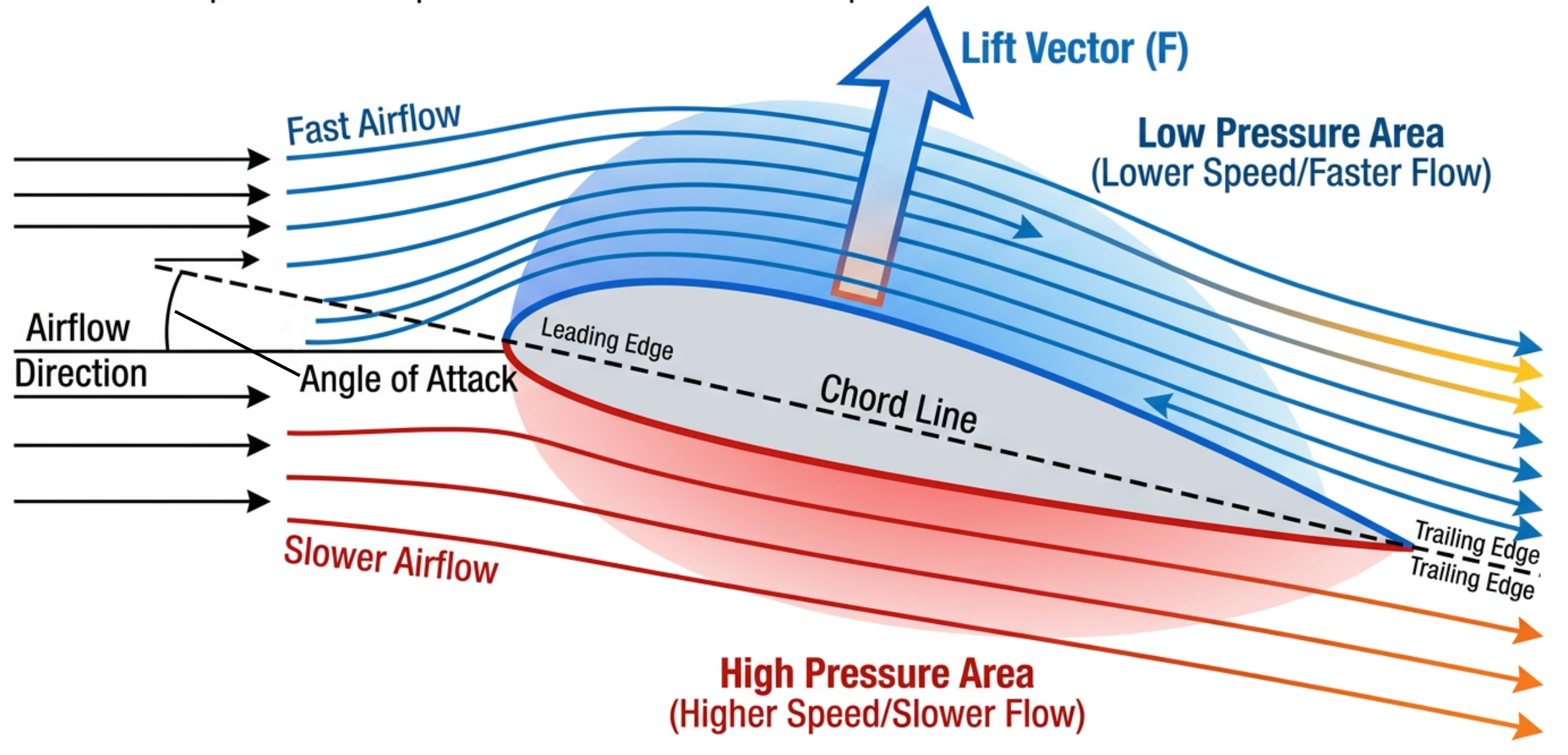
Bernoulli's principle works in conjunction with the Continuity Equation: \( A_1 v_1 = A_2 v_2 \). When airflow is constricted (e.g., by the curvature of the upper wing surface), velocity must increase to maintain the same mass flow rate. This increased velocity is what creates the pressure drop described by Bernoulli.
Total, Static and Dynamic Pressure
Bernoulli's equation is the reason the pitot-static system works at all. At the mouth of the pitot tube the flow is brought completely to rest at the stagnation point, where velocity is zero and the measured pressure is the full total (pitot) pressure. The static ports, set flush in undisturbed flow along the fuselage, sense static pressure alone. The airspeed indicator capsule is fed both and responds to the difference, so an indicated airspeed reading is really a direct measurement of dynamic pressure \( \tfrac{1}{2} \rho v^2 \), not of speed through the air. That is why a wing loaded to a given IAS carries the same aerodynamic load at any altitude, and why the aeroplane's structural and stall speeds are quoted in indicated terms.
Where the Theorem Applies — and Where It Does Not
The equation assumes a fluid that is inviscid and of constant density, so it holds well for subsonic flight at low Mach numbers and becomes progressively less accurate as compressibility takes effect above roughly M 0.3 to 0.4, where the air is measurably squeezed and the simple form must be corrected. It also applies only outside the boundary layer: inside it, viscosity dissipates energy, so total pressure is not conserved. That single limitation explains most of the wing's practical behaviour — air that has lost energy in the boundary layer cannot climb the rising pressure towards the trailing edge, which is why separation happens and why devices such as slots, slats and vortex generators work by adding energy to that layer rather than by manipulating pressure alone.
The same convergent-passage effect is used deliberately in a wing slot, which behaves as a venturi: air is accelerated through the narrowing gap from the high-pressure lower surface and discharged over the upper surface as a fast, high-energy sheet. A Krueger flap makes an instructive contrast — it hinges forward and down from the lower surface of the leading edge and forms no slot at all, raising the stalling angle by adding leading-edge camber instead of by feeding energised air over the top. Both devices raise the critical angle of attack, so the difference between a slat and a Krueger flap is the presence of the slot, not the effect on the stall.
Dynamic Pressure and the Working Lift Coefficient
Because dynamic pressure varies with the square of speed, and because lift must continue to equal weight in level flight, the lift coefficient the wing is actually working at varies inversely with the square of the speed. Speeding up in level flight therefore forces \( C_L \) — and with it the angle of attack — to reduce; slowing down forces both to increase. The rigging (incidence) angle between the chord line and the airframe datum is fixed by the structure and never changes in flight, so a change of angle of attack is always a change in the aircraft's attitude or flight path, never a change of incidence.
Dynamic pressure at 100 m/s at ISA sea level: \( q = 0.5 \times 1.225 \times 100^2 = 6125 \) Pa.
Doubling the IAS multiplies \( q \) by four, so to hold lift equal to weight the lift coefficient must be multiplied by \( 1/4 = 0.25 \).
Flying at 1.3 times the stall speed, \( q \) is \( 1.3^2 = 1.69 \) times the value at the stall, so \( C_L = C_{L_{max}} \div 1.69 \approx 0.59 \) — about 59% of \( C_{L_{max}} \).
Examiners separate two flap questions that look identical. At constant IAS in straight and level flight, lift still equals the same weight at the same dynamic pressure, so the working \( C_L \) is unchanged; what flap deployment raises is the available \( C_{L_{max}} \), together with the drag. At constant angle of attack, nothing balances the extra lift the added camber produces, so lift momentarily exceeds weight and the aeroplane climbs. Note also that adding camber shifts the section's zero-lift angle more negative, so a flapped section behaves as though it were at a larger angle of attack for the same attitude — while the aircraft, holding a constant IAS, ends up flying at a lower nose attitude.
Boundary Layer
The boundary layer is the thin layer of air immediately adjacent to the aircraft surface where the air velocity transitions from zero (at the surface, due to viscosity) to the free-stream velocity. It is critical because drag, heat transfer, and surface contamination effects all occur within this layer.
Types of Boundary Layer Flow
| Type | Characteristics | Drag |
|---|---|---|
| Laminar | Smooth, orderly layers of air sliding over each other; occurs near the leading edge; thin boundary layer | Low skin friction drag |
| Turbulent | Chaotic mixing of air; occurs further back along the surface; thicker boundary layer; better at resisting flow separation | Higher skin friction drag |
| Transition point | The location where laminar flow changes to turbulent flow; varies with Reynolds number, surface roughness, and pressure gradient | — |
Free-stream flow is the undisturbed airflow outside the boundary layer. Relative airflow is the direction of airflow relative to the aerofoil — equal and opposite to the direction of flight.
Surface roughness (dents, protruding rivet heads, peeling paint, insect residue, ice crystals) causes the laminar-to-turbulent transition to occur earlier, increasing drag and potentially causing flow separation. This is why maintaining smooth aerodynamic surfaces is critical during maintenance — even a thin layer of frost can increase drag by 30–40% and reduce lift significantly.
How the Boundary Layer Grows and Why It Separates
The layer starts vanishingly thin at the stagnation point and thickens with distance aft as more and more air is dragged along by friction. Ahead of the point of maximum thickness of the aerofoil the flow is accelerating into falling pressure, which is a stable, helpful condition. Behind it the pressure rises again towards the trailing edge — an adverse pressure gradient — and the air nearest the surface, already slowed by viscosity, must climb it on the momentum it has left. When that momentum is exhausted the flow near the surface stops, reverses, and the main stream lifts away: this is separation, and it is what a stall, a spoiler and a contaminated wing all have in common.
The two flow types behave differently for exactly this reason. A laminar layer is thin and carries little momentum close to the surface, so although it produces low skin friction it gives way to an adverse gradient early. A turbulent layer continuously mixes fast air from above down towards the wall, so it holds on much further aft at the cost of higher friction. Real wings are therefore a compromise, and every boundary layer control device on the aircraft is an attempt to buy the separation resistance of turbulent flow without paying for it over the whole surface.
\( Re = \dfrac{\rho\, v\, L}{\mu} \)
The ratio of inertia forces to viscous forces, where \( L \) is a characteristic length (chord, or distance from the leading edge) and \( \mu \) is the dynamic viscosity of the air. A high Reynolds number means inertia dominates and the flow trips into turbulence readily; this is why the transition point on a full-size wing sits much further forward, as a fraction of chord, than on a small model of the same shape.
The Stagnation Point and Angle of Attack
The stagnation point is where the oncoming flow divides, and it is not fixed. At a high angle of attack it lies well back under the leading edge, so the air that goes over the top must whip around a tighter corner, producing a sharp suction peak and a correspondingly steep adverse gradient behind it — the reason separation starts near the leading edge at high angles. As the aircraft accelerates in level flight and the angle of attack reduces, the stagnation point migrates forward towards the leading edge and that suction peak flattens out. That acceleration also raises the Reynolds number, but it does not follow that the transition point simply marches forward with speed: transition is set by the pressure gradient as well as by Reynolds number, and the falling angle of attack moves the point of minimum pressure aft, which extends the favourable gradient and works against any forward movement. What is certain in a level acceleration is that lift must continue to equal weight while the dynamic pressure rises, so the lift coefficient must reduce.
Because the layer is thinnest near the leading edge, a surface defect there is far more damaging than the same defect further aft. A proud rivet head, a step at a repair doubler, an unfaired sealant bead, filler that has shrunk, or leading-edge erosion all sit inside a layer only a fraction of a millimetre thick and can trip it or thicken it out of proportion to their size. Repairs in the forward part of the chord are consequently held to tighter contour and flushness limits than repairs further aft, and the structural repair manual will normally say so explicitly.
Generation of Lift
Lift is the aerodynamic force generated perpendicular to the relative airflow. It is produced by the pressure difference between the upper and lower surfaces of the wing, combined with the deflection of airflow (Newton's Third Law — the wing pushes air down, and the air pushes the wing up).
\( L = C_L \times \tfrac{1}{2} \rho v^2 \times S \)
Where:
- \( L \) = lift force (Newtons)
- \( C_L \) = lift coefficient (depends on aerofoil shape and angle of attack)
- \( \rho \) = air density (kg/m³)
- \( v \) = airspeed (m/s)
- \( S \) = wing planform area (m²)
Angle of Attack (AoA)
The angle of attack (α) is the angle between the chord line of the aerofoil and the relative airflow. As AoA increases, \( C_L \) increases (more lift is generated) — up to the stall angle (typically 15–18° for conventional aerofoils), beyond which \( C_L \) drops sharply as the airflow separates from the upper surface.
Centre of Pressure (CP)
The centre of pressure is the point on the chord line where the total aerodynamic force (resultant of lift and drag) effectively acts. As AoA increases, the CP moves forward; as AoA decreases, the CP moves aft. This movement affects the aircraft's pitching moment and longitudinal stability.
Aerofoil Types
| Type | Characteristics | Typical Use |
|---|---|---|
| Symmetrical | Upper and lower surfaces are mirror images; zero lift at zero AoA; CP does not move | Tailplanes, aerobatic aircraft |
| Cambered (asymmetric) | Upper surface more curved than lower; generates lift at zero AoA; higher max \( C_L \) | Most transport wings |
| Supercritical | Flattened upper surface delays shock wave formation; higher critical Mach number | Modern transport aircraft (A320, B737) |
| Laminar flow | Maximum thickness further aft; maintains laminar flow over larger area; lower drag | High-performance gliders, some GA aircraft |
Drag
Drag is the aerodynamic force that opposes the aircraft's motion through the air. Total drag is the sum of two main components:
\( D = C_D \times \tfrac{1}{2} \rho v^2 \times S \)
Total Drag = Parasite Drag + Induced Drag
Parasite Drag
Parasite drag (also called zero-lift drag) is drag that is not directly associated with lift production. It increases with speed squared. Components:
- Form drag (pressure drag) — caused by the shape of the aircraft; the pressure difference between front and rear surfaces. Streamlining reduces form drag.
- Skin friction drag — caused by air viscosity in the boundary layer rubbing against the aircraft surface. Smooth surfaces reduce skin friction.
- Interference drag — caused by the interaction of airflows at junctions (wing-fuselage, engine pylon-wing). Fairings reduce interference drag.
Induced Drag
Induced drag is drag that is a direct consequence of lift production. High-pressure air below the wing tip flows around to the low-pressure area above, creating wing-tip vortices. These vortices deflect the airflow downward (downwash), tilting the lift vector backward and creating an aft-acting component — induced drag. Key points:
- Induced drag decreases with speed (at higher speeds, less AoA is needed for the same lift, producing weaker vortices)
- Induced drag increases with AoA and weight
- High aspect ratio wings produce less induced drag (less tip vortex relative to wing area)
- Winglets reduce induced drag by limiting the spanwise flow at the wing tip
Ground Effect
When the aircraft is within approximately one wingspan of the ground, the ground disrupts the formation of wing-tip vortices, significantly reducing induced drag. This is called ground effect. It makes the aircraft feel like it is "floating" during the landing flare and can cause the aircraft to become airborne at a speed below normal take-off speed. Ground effect reduces induced drag by up to 50% when very close to the surface.
Lift/Drag Ratio and Aircraft Polar Diagram
The lift/drag ratio (L/D) is a measure of aerodynamic efficiency. It represents how many units of lift are generated for each unit of drag. The maximum L/D ratio occurs at a specific AoA and speed — this is the speed for maximum range and best glide performance.
- Typical L/D max for a modern transport aircraft: 15:1 to 20:1
- Typical L/D max for a glider: 30:1 to 60:1
- The aircraft polar diagram plots \( C_L \) against \( C_D \). A tangent line from the origin to the curve gives the angle of attack for maximum L/D ratio.
The Drag Curve — Why L/D Max Sits Where It Does
The two families of drag pull in opposite directions with speed. Parasite drag grows with the square of speed, while induced drag falls off as speed rises, because less angle of attack is needed to carry the weight and the tip vortices weaken. Adding the two curves gives a total-drag curve shaped like a shallow bucket, and its lowest point — where parasite drag and induced drag are equal — is the minimum drag speed, \( V_{IMD} \). Since lift equals weight throughout, minimum drag and maximum lift/drag ratio are the same condition, reached at one angle of attack and, for a given weight, one speed.
| Speed region | Dominant drag | Behaviour |
|---|---|---|
| Below \( V_{IMD} \) | Induced (high angle of attack, strong vortices) | Drag increases as speed decreases — the "back of the drag curve"; speed is not self-correcting and thrust must be added to accelerate back out |
| At \( V_{IMD} \) | Induced equals parasite | Minimum total drag, maximum L/D, best glide range, minimum thrust required for level flight |
| Above \( V_{IMD} \) | Parasite (rising with the square of speed) | Drag increases with speed in the ordinary way; speed is stable and self-correcting |
Anything that reduces induced drag lowers the induced curve, so the crossing point moves to a lower speed and the peak L/D rises. Increasing aspect ratio does exactly this: it reduces induced drag and therefore reduces the speed for minimum drag. Increasing weight has the opposite effect, raising the induced curve and pushing \( V_{IMD} \) up in proportion to the square root of weight, while leaving the best lift/drag ratio itself unchanged, since that is set by the angle of attack.
In a steady glide the lift/drag ratio is the glide ratio: distance travelled divided by height lost. A transport aircraft gliding at an L/D of 17 from 30,000 ft covers \( 17 \times 30{,}000 = 510{,}000 \) ft in still air, which is \( 510{,}000 \div 6076 \approx 84 \) nautical miles.
A heavier aircraft glides the same distance, but must fly faster to do it — the angle is unchanged, only the speed at which that angle is achieved. Lowering the landing gear, extending flap or deploying spoilers cuts the achievable L/D sharply and the distance with it.
On the polar diagram, the point of minimum drag coefficient is not the point of best L/D: minimum \( C_D \) lies at the leftmost point of the curve, whereas maximum L/D is found where a straight line drawn from the origin just touches the curve. Reading the corresponding \( C_L \) and \( C_D \) at that tangent point gives both the best ratio and the angle of attack that produces it.
Stalling
A stall occurs when the angle of attack exceeds the critical angle (stall angle, typically 15–18°). The airflow can no longer follow the upper surface contour, separates from the wing, and lift decreases dramatically while drag increases sharply.
Key Stall Facts
- A stall is an angle of attack event, NOT a speed event — an aircraft can stall at ANY speed if the critical AoA is exceeded
- However, the stall speed is the minimum speed at which the aircraft can maintain level flight at 1g (with maximum \( C_L \))
- Stall speed increases with: weight (heavier = more lift needed = higher speed), load factor (in turns), altitude (lower density), but that applies to true airspeed only — the stalling IAS/EAS for a given weight and configuration does not change with altitude — and forward CG (more tail down-force needed)
- Stall speed decreases with: use of flaps/slats (increase \( C_{L_{max}} \))
Stall Warning Systems
- Stall warning vane (angle of attack sensor) — a small vane on the fuselage side that measures the local AoA; triggers warnings before the stall angle is reached
- Stick shaker — vibrates the control column to give a tactile warning of approaching stall
- Stick pusher — automatically pushes the control column forward to reduce AoA and prevent a full stall (used on T-tail aircraft where a "deep stall" is irrecoverable)
Load Factor and Stall Speed
In a level turn the wing must support more than the weight, because the lift vector is tilted and only its vertical component opposes gravity. The ratio of lift produced to weight carried is the load factor, and since lift depends on the square of speed, the stall speed rises with the square root of the load factor — not in direct proportion to it, and not with weight or lift as such.
\( V_{S_{turn}} = V_S \sqrt{n} \qquad n = \dfrac{1}{\cos \phi} \)
Where \( n \) is the load factor and \( \phi \) the angle of bank in a level turn. Weight enters the same way: \( V_S \) varies with the square root of weight, so a 21% weight increase raises the stall speed by about 10%.
An aeroplane stalls at 100 kt in level flight. In a 45° banked level turn, \( n = 1 \div \cos 45° = 1.41 \) and \( \sqrt{1.41} = 1.19 \), so the stall speed becomes about 119 kt.
At a load factor of 1.5, \( \sqrt{1.5} = 1.22 \), giving about 122 kt. A load factor of 2 would be needed to reach 141 kt — the value candidates often pick by mistake.
Two further influences are easy to miss. A forward centre of gravity lengthens the arm between the CG and the tailplane, so more download is needed on the tail to hold the nose up; the wing must carry that download as well as the weight, and the stall speed rises. A reduction in thrust removes the small vertical component of thrust that was helping to support the aircraft at high nose attitudes, so the wing must supply more lift and again stalls sooner. Both of these raise stall speed, while additional flap and lower weight lower it.
The Stalling Angle Never Changes
Every one of those factors changes the speed at which the wing reaches the critical angle; none of them changes the angle itself, which is fixed by the shape of the aerofoil section. Gross weight, altitude, bank angle and a steady climb all leave the stalling angle where it was. This is precisely why certified stall protection senses angle of attack rather than airspeed: one threshold remains valid at every weight, altitude and bank angle, whereas a speed threshold would need constant correction. It also explains why the stalling equivalent airspeed for a given weight and configuration is the same at all altitudes even though the true airspeed at the stall keeps rising.
The centre of pressure reaches its most forward position at the stalling angle. Beyond that angle the leading-edge suction peak collapses as the flow separates and the centre of pressure moves sharply rearward, producing a nose-down pitching moment that helps the aeroplane lower its nose and recover.
How the Stall Spreads Across the Span
A wing does not stall everywhere at once. Designers deliberately arrange for the root to stall first — by washout, by a different root section, or by stall strips — so that the outboard wing keeps flying and the ailerons remain effective while the separated wake from the root beats over the tailplane and gives the pilot airframe buffet as a natural warning. If the tip stalls first the opposite happens: lift is lost outboard and behind the centre of gravity, which on a swept wing produces a wing drop combined with a pitch-up just as control authority is disappearing. On a T-tail aircraft, a fully developed stall can leave the tailplane immersed in the wing's separated wake, so that the elevator becomes ineffective and the aircraft is locked into a deep stall — the reason those types are fitted with a stick pusher rather than a shaker alone.
The angle of attack vane measures the local flow direction at its mounting position and is calibrated for that position, so a vane installed on the wrong side, indexed to the wrong datum, or obstructed by tape, paint or a badly faired repair will give a false margin. Vane heaters must be serviceable before flight in icing conditions — a frozen vane can sit at a benign angle and never trigger. The stall warning, stick shaker and, where fitted, stick pusher have scheduled functional tests, and the pusher circuit normally has an inhibit or disconnect facility that must be confirmed in the correct state before release to service.
Aerofoil Contamination
Contamination of the wing surface — even a very thin layer — disrupts the boundary layer and degrades aerodynamic performance. This is one of the most safety-critical maintenance considerations.
| Contaminant | Effect |
|---|---|
| Frost | Even a thin layer of frost roughens the surface, causing early boundary layer transition. Can reduce lift by up to 30% and increase stall speed. Aircraft must be de-iced before departure — the "clean aircraft concept." |
| Ice | Changes the aerofoil shape, reducing lift and increasing drag. Can add significant weight. Rime ice (rough, opaque) is worse than glaze ice (smooth, clear) for drag increase. |
| Rain (heavy) | Water film increases surface roughness, adds weight, and can cause premature boundary layer transition. Typically 5–15% lift reduction in very heavy rain. |
| Insects | Insect residue near the leading edge disturbs the boundary layer. On laminar-flow wings, can cause significant drag increase. Aircraft operating in tropical regions require regular leading-edge cleaning. |
EASA regulations require that an aircraft must be "clean" — free of all frost, ice, snow, and slush — before take-off. This is known as the clean aircraft concept. Ground de-icing and anti-icing procedures (using heated Type I/II/III/IV fluids) are applied to ensure compliance. The holdover time is the period during which anti-icing fluid remains effective after application; if exceeded before take-off, the aircraft must be re-treated.
Why So Little Contamination Does So Much
The damage is done in the first few per cent of chord, where the boundary layer is at its thinnest and where the suction peak that produces most of the lift is generated. Roughness there trips the layer to turbulent flow immediately, thickens it, and leaves it with far less energy to climb the adverse pressure gradient behind the point of maximum thickness. Separation therefore begins earlier along the chord and at a lower angle of attack than on a clean wing, so the aeroplane loses not only maximum lift but part of its margin to the stall.
Stall protection is calibrated to the clean aerofoil. If contamination has lowered the angle at which the wing actually separates, the aircraft can stall before the angle of attack vane reaches its trigger angle, so the stick shaker fires late or not at all. Contamination is also rarely symmetrical — one wing shaded from the sun, or one wing over a fuel tank still cold from cruise — and the more contaminated wing stalls first, giving an uncommanded roll at low altitude with the ailerons already close to their limit. This combination, not the raw lift loss alone, is what makes wing contamination lethal.
Where Contamination Hides
- Cold-soaked fuel frost — after a long sector the fuel in the tanks is far colder than the ambient air, and frost or clear ice forms on the upper wing skin above the tanks even on a warm, dry day with no precipitation. It can be almost invisible and is found by touch.
- Clear ice on the lower surface — forms over the same cold tank skins; upper-surface clear ice is the more serious case because it is where the lift is made and it is the hardest of all contamination to see.
- Quiet areas — hinge lines, control surface gaps, the fin and stabiliser leading edges, and the wing-to-fuselage fairing collect frozen deposits and dried thickened fluid that can re-hydrate and refreeze, in the worst case restricting a control surface.
- Probes, vanes and drains — the pitot heads, static ports, total air temperature probe, angle of attack vanes and drain masts must all be clear, and must not be sprayed directly during de-icing.
How the Fluids Work
The two functions are distinct. De-icing removes what is already on the aircraft, and is done with a hot, thin, unthickened fluid whose heat does the work; it leaves almost no protection behind. Anti-icing puts down a thickened fluid that stays in place as a protective film and absorbs falling precipitation. Thickened fluids are pseudoplastic: they are viscous at rest but shear-thin under the airflow of the take-off roll and flow off the wing before rotation — which is why they are only cleared for aircraft whose rotation speed is high enough to shed them, and why the wing must not be walked on or wiped after application. When both are needed the treatment is done as a two-step process, and the holdover clock starts at the beginning of the final application, not when the truck drives away.
Maintenance rules follow from the same physics. Frozen deposits are never chipped, scraped or knocked off, because the damage left in the skin and the leading edge is itself an aerodynamic defect and can also mask corrosion; approved fluid or warm hangarage is the only method. Only fluids to the correct specification and mix ratio may be used, and dilution is checked with a refractometer against the type approved for the conditions. Insect residue and dried fluid are removed with approved cleaners rather than abrasives, since polishing through the paint on a laminar-flow leading edge trades one contamination problem for a permanent surface-finish one.
Stability
Stability is the tendency of an aircraft to return to its original state after being disturbed (e.g., by a gust). There are two aspects:
- Static stability — the initial tendency after a disturbance:
- Positive — tends to return to original state (nose drops after gust pitches it up)
- Neutral — remains in the new state (no tendency to return or diverge)
- Negative — tends to diverge further from original state (undesirable)
- Dynamic stability — describes the motion over time:
- Positive — oscillations decrease in amplitude over time (returns to equilibrium)
- Neutral — oscillations continue at constant amplitude (neither increasing nor decreasing)
- Negative — oscillations increase in amplitude (divergent — dangerous)
Three Axes of Stability
| Axis | Motion | Primary Stabilising Surface | Key Factors |
|---|---|---|---|
| Longitudinal (pitch) | Nose up/down about lateral axis | Horizontal stabiliser (tailplane) | CG position relative to CP; tailplane area and moment arm |
| Lateral (roll) | Wing up/down about longitudinal axis | Wing dihedral, swept wings | Dihedral angle, wing sweep, high/low wing position |
| Directional (yaw) | Nose left/right about vertical axis | Vertical stabiliser (fin) | Fin area and moment arm; fuselage side area |
Longitudinal Stability: Centre of Gravity and Neutral Point
The restoring moment in pitch comes from the tailplane. A gust that raises the nose increases the angle of attack of the wing and of the tailplane; the tailplane's extra lift acts on a long arm behind the centre of gravity and produces a nose-down moment that opposes the disturbance. Whether the aircraft as a whole is stable depends on where the centre of gravity lies relative to the neutral point — the position at which the wing and tail contributions exactly cancel. With the CG ahead of the neutral point the aircraft is statically stable in pitch, and the distance between them, expressed as a percentage of the mean aerodynamic chord, is the static margin.
This is why the loading limits matter to the engineer as much as to the loadmaster. A forward CG gives a large static margin: the aircraft is very stable, but stick forces are heavy, more tail download is carried, the stall speed is higher and more elevator authority is consumed in the landing flare. An aft CG gives light stick forces and less trim drag, but a small static margin, sluggish natural recovery from a disturbance and, at the limit, a nose-up tendency at the stall that the elevator may be unable to overcome.
Configuration changes disturb this balance and the trim system has to absorb them. Lowering large trailing-edge flaps adds camber and, in the case of a Fowler flap, moves the flap physically aft, so the wing's centre of pressure shifts rearward and generates a nose-down pitching moment. On a conventional low-set tailplane the increased downwash behind the flapped wing strikes the tail and produces a compensating nose-up effect, so the net change the pilot feels is modest. On a high-set T-tail that downwash largely passes below the tailplane, nothing offsets the wing's moment, and the aircraft is left with a net nose-down pitch change on flap extension that the stabiliser trim must take out.
How Lateral and Directional Stability Are Produced
Lateral stability works through sideslip, not through roll directly. When a wing drops, the aircraft slides towards the low wing; with dihedral, the low wing then meets that sideways component of airflow at a greater effective angle of attack than the raised wing, generates more lift and rolls the aircraft level again. Wing sweep produces the same effect by a different route — the wing angled into the slip presents less effective sweep and a longer effective span to the flow — and a high wing adds a further contribution of its own. In a sideslip the fuselage deflects the oncoming flow upwards over the windward wing root and downwards over the leeward one, raising the effective angle of attack on the wing that is into the slip and lowering it on the other, which rolls the aircraft back towards level. The side (keel) area of the fin and the upper fuselage adds to this because the net side area lies above the centre of gravity, so the side force the slip generates acts on a moment arm that rights the aircraft; net side area acting below the centre of gravity does the opposite and rolls the aircraft further into the slip, which is why a deep lower fuselage or a large ventral fin subtracts from lateral stability rather than adding to it. The pendulum argument often quoted alongside the high wing is a separate one about mass rather than area — the fuselage and payload hang below a high wing — and the two should not be run together: it is the mass that has to be low, and the side area that has to be high. Modern swept, high-wing transports frequently need anhedral to subtract some of this effect, because too much lateral stability is as troublesome as too little.
Directional stability comes from the fin and the fuselage side area behind the centre of gravity. Because the fin is a symmetrical section it develops no side load at all while it is aligned with the airflow; a side load appears as soon as it meets the flow at an angle, and that angle can be produced either by the aircraft yawing into a sideslip or by deflecting the rudder, which cambers the section. Both routes are valid, which is what allows the fin to act as a weathercock in a sideslip and as a control surface support at the same time.
Dynamic Modes
| Mode | Motion | Typical character |
|---|---|---|
| Phugoid | Slow exchange of height and speed at almost constant angle of attack | Long period, lightly damped; easily controlled by the pilot, so weak damping is acceptable |
| Short-period pitch oscillation | Rapid oscillation in angle of attack at almost constant speed | Must be heavily damped and die out quickly, or the aircraft is unflyable |
| Dutch roll | Combined yaw and roll oscillation — strong lateral stability against weak directional stability | Characteristic of swept-wing transports; controlled by a yaw damper acting on the rudder |
| Spiral | Slow divergence in a steepening banked descent — strong directional stability against weak lateral stability | Often mildly divergent by design; slow enough for the pilot or autopilot to correct |
Dutch roll and spiral instability sit at opposite ends of the same design compromise, so a swept-wing aircraft is deliberately given a slightly divergent spiral mode in exchange for a Dutch roll that the yaw damper can handle. That makes the yaw damper a required item on many types, and dispatch with it inoperative is normally limited by the minimum equipment list to reduced altitudes and speeds. For the engineer, the practical consequences of stability are rigging consequences: a wing repaired to the wrong dihedral, a fixed trim tab bent to an unapproved setting, a mis-rigged control cable tension or a stabiliser trim indication out of calibration all change the aircraft's natural behaviour before any pilot input is made.
Wing Planforms
| Feature | Definition | Effect |
|---|---|---|
| Aspect ratio | Span² ÷ wing area (or span ÷ mean chord) | High AR = less induced drag, better L/D (gliders); Low AR = better manoeuvrability (fighters) |
| Wing sweep | Angle of the leading edge from perpendicular to fuselage | Increases critical Mach number; provides directional stability; increases stall speed; tip stall tendency |
| Taper | Reduction in chord from root to tip (taper ratio = tip chord ÷ root chord) | Reduces structural weight; approximates elliptical lift distribution; reduces induced drag |
| Washout (twist) | Wing tip has lower incidence angle than wing root | Root stalls before tip — preserves aileron control during stall; prevents tip stall on swept wings |
| Mean Aerodynamic Chord (MAC) | Chord of a rectangular wing with the same area, same pitching moment and same lift | Used as reference for CG position (expressed as % MAC) |
Working with the Geometry
\( \text{mean chord} = \dfrac{S}{b} \qquad AR = \dfrac{b^2}{S} = \dfrac{b}{\text{mean chord}} \)
Where \( b \) is the span and \( S \) the wing area. Centre of gravity position is quoted against the mean aerodynamic chord:
\( \%\,\text{MAC} = \dfrac{\text{distance of CG aft of the MAC leading edge}}{\text{MAC}} \times 100 \)
A wing spans 50 ft and has an area of 200 ft². Its mean chord is \( 200 \div 50 = 4 \) ft, and its aspect ratio is \( 50^2 \div 200 = 2500 \div 200 = 12.5 \) — the same answer as span divided by mean chord, \( 50 \div 4 = 12.5 \).
If that aircraft's MAC were 4 ft and the centre of gravity were found 1 ft aft of the MAC leading edge, the CG would be at \( (1 \div 4) \times 100 = 25\% \) MAC.
Sweep — What It Buys and What It Costs
Only the component of the airflow perpendicular to the leading edge shapes the pressure distribution over the section; the spanwise component simply slides along the wing. Sweeping the wing therefore presents the section with an effective velocity reduced by the cosine of the sweep angle, so the aircraft can fly considerably faster before any point on the wing reaches the local speed of sound. The price is paid at low speed: the same cosine factor reduces the lift the section produces, so a swept wing has a lower maximum lift coefficient and needs more high-lift device area to achieve an acceptable approach speed.
Two different spanwise flows have to be kept apart here, because they run in opposite directions and both are examined. The first exists on any wing of finite span and is driven by the pressure difference between the surfaces. The lower surface is at higher pressure and the upper surface at lower pressure, and the two are free to meet around the tip, so on the lower surface the flow drifts outward, towards the tip, where it spills around into the tip vortex, while on the upper surface it drifts the other way, inward towards the root. Anything that increases the pressure difference strengthens both drifts, which is why deploying large trailing-edge flaps increases the outward spanwise flow on the lower surface and makes the tip vortices visibly stronger — the increase is on the lower surface, not the upper one.
Sweep adds a second, quite separate spanwise flow, and this one lives inside the boundary layer on the upper surface. Because the isobars on a swept wing run along the span rather than across it, there is a pressure gradient acting outboard, and the slow air deep in the boundary layer has too little momentum to resist it, so it is dragged steadily towards the tip as it travels aft. It arrives there thick and low in energy, so the tip is the first place to separate — and because the tip of a swept wing lies behind the centre of gravity, losing its lift produces a nose-up pitching moment at the very moment the ailerons are losing their grip. That single mechanism is the reason swept wings carry washout, wing fences, saw-tooth leading edges, vortex generators and stall strips, and it is why those items are not cosmetic. There is no contradiction between the two flows: the outboard drift belongs to the retarded air inside the upper-surface boundary layer on a swept wing, while the root-ward drift described above belongs to the main flow outside it.
Twist and Tip Devices
Washout can be built in two ways. Geometric washout is a physical twist in the structure that sets the tip at a smaller angle of incidence than the root, so as the aircraft is slowed the root reaches the stalling angle while the tip is still several degrees below it. Aerodynamic washout achieves the same end without twist, by using a section at the tip with a higher stalling angle than the section at the root. Either way the intent is identical: the root stalls first and the ailerons keep working.
Wingtip devices attack the tip vortex itself rather than the lift distribution. By obstructing the flow spilling from the lower surface to the upper surface at the tip, a winglet weakens the vortex and reduces induced drag; as a side effect the extra side area above the wing gives a small increase in static lateral stability. What it does not do is create an elliptical lift distribution — that is the job of planform taper and twist. A winglet also lengthens the effective load path, increasing the bending moment at the wing root, which is why a retrofit is a structural modification requiring reinforcement and a revised inspection programme, not simply a bolt-on aerodynamic part.
Control Around Three Axes
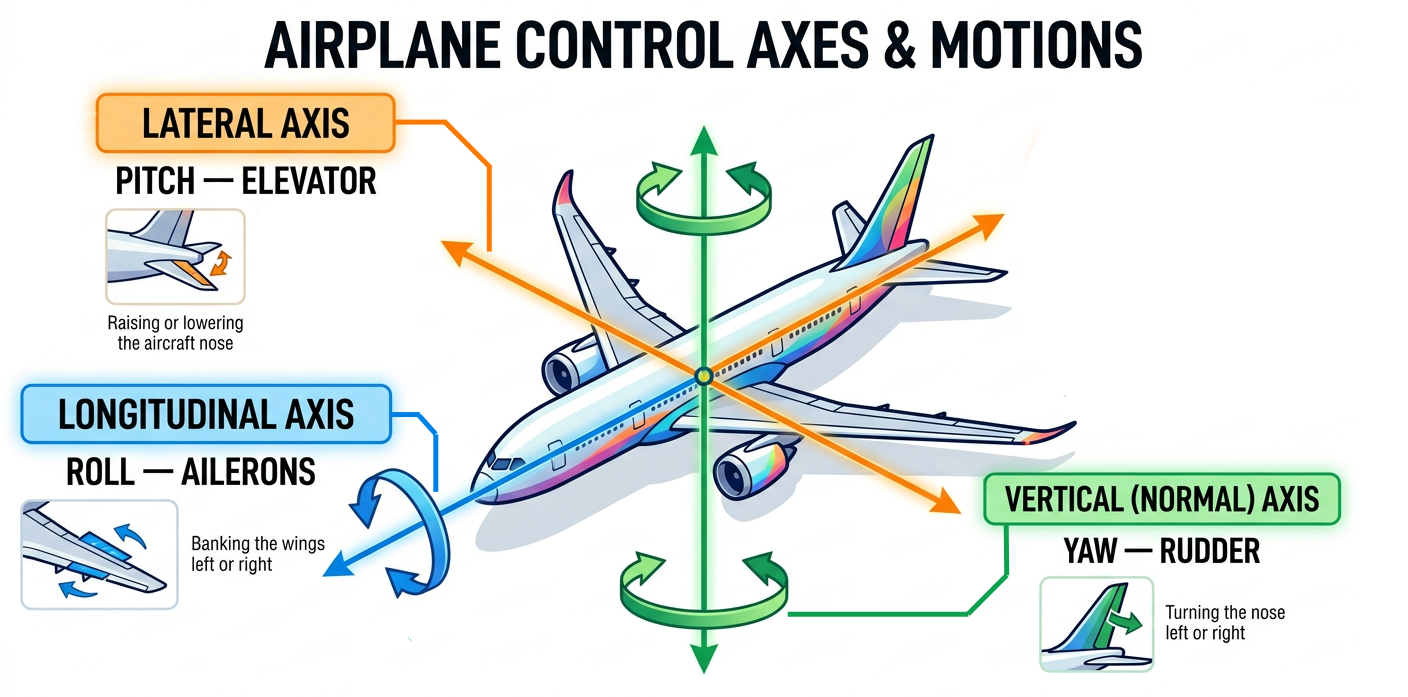
The three axes are mutually perpendicular and all three pass through the centre of gravity. That is the point about which the aeroplane actually rotates in flight, wherever the control force happens to be applied, because in free flight there is nothing else for it to pivot around. A control surface works by changing the camber of the surface it is attached to, which changes the aerodynamic force that surface produces; that force acts a long way from the centre of gravity, and the resulting moment is what turns the aircraft.
\( M = F \times d \qquad F \propto \tfrac{1}{2} \rho v^2 \times \text{area} \times \text{deflection} \)
The moment available depends on the force generated by the surface and on \( d \), its distance from the centre of gravity. Because the force contains the dynamic pressure term, control effectiveness varies with the square of the indicated airspeed.
Two practical consequences follow. At low indicated airspeed the same full deflection produces only a weak moment, which is why the controls feel soft on the approach and why the aircraft is flown with larger, earlier inputs; and at high indicated airspeed a small deflection produces a very large moment and a very large structural load, which is why maximum control travel is restricted at speed on many types. A control input in roll is also different in kind from one in pitch or yaw: a held aileron deflection produces a steady rate of roll, because roll damping from the wings rises with roll rate until it balances the input, whereas a held elevator or rudder deflection settles the aircraft at a new attitude.
Primary and Further Effects
| Input | Primary effect | Further effect and mechanism |
|---|---|---|
| Aileron | Roll about the longitudinal axis | Yaw away from the turn (adverse yaw): the down-going aileron adds lift and therefore induced drag on the rising wing. Once banked, the tilted lift vector also turns the aircraft. |
| Rudder | Yaw about the vertical axis | Roll in the same direction as the yaw: the outer wing travels faster through the air and generates more lift. A yaw to the right therefore tends towards a right-wing-low attitude. |
| Elevator | Pitch about the lateral axis | Change of speed and of angle of attack; in a sustained turn, back pressure is also what converts bank into turn rate rather than into a descent. |
After any work that disturbs a flying control system the check is not simply that the surface moves. It must move through its full range against the stops, freely without binding or interference throughout that range, and in the correct sense for the cockpit input — verified by an engineer watching the surface, not deduced from the cockpit. Reversed rigging is one of the classic fatal maintenance errors, and it is why control systems are subject to a duplicate inspection by a second qualified person after assembly, adjustment or repair.
Primary Flight Controls
| Control | Location | Axis | Movement | Cockpit Control |
|---|---|---|---|---|
| Ailerons | Wing trailing edge (outboard) | Longitudinal (roll) | Move differentially — one up, one down | Control wheel/stick left/right |
| Elevators | Horizontal stabiliser trailing edge | Lateral (pitch) | Move together — both up or both down | Control column forward/backward |
| Rudder | Vertical stabiliser trailing edge | Vertical (yaw) | Moves left or right | Rudder pedals left/right |
Hinge Moment, Balance and Feel
The force a deflected surface generates acts at some distance behind its hinge line, and the product of the two is the hinge moment the pilot or the actuator must overcome. It grows with dynamic pressure and with deflection, so an unassisted control that is pleasant at circuit speed can be immovable at cruise. Designers reduce it aerodynamically by placing part of the surface ahead of the hinge, either as a horn balance at the tip or as a set-back (inset) hinge along the span, so that the air load on the forward portion helps to drive the surface in the direction of movement. Too much balance is as bad as too little: an over-balanced surface tends to run away from neutral of its own accord.
Mass balance is a different thing entirely and must not be confused with aerodynamic balance. Weights are fitted ahead of the hinge line so that the centre of gravity of the surface itself lies on or slightly ahead of the hinge, preventing the inertial coupling between wing bending and surface rotation that drives flutter — a destructive divergent oscillation that can remove a surface in seconds. This is why a control surface may not be repainted, repaired, re-skinned or have a balance weight disturbed without a static balance check to the manufacturer's figures afterwards, and why water trapped inside a surface is a serious airworthiness defect rather than a nuisance. On fully powered controls the pilot is disconnected from the air loads altogether, so an artificial feel system provides the missing cue, typically increasing feel force with dynamic pressure and adding a centring spring.
Adverse Yaw and the Ways It Is Cured
- Differential ailerons — the linkage geometry gives the up-going aileron a larger angular travel than the down-going one, so the down-going aileron moves through the smaller angle. This raises the drag on the descending wing and reduces the drag difference that causes adverse yaw.
- Frise ailerons — the up-going aileron's blunt leading edge projects below the wing into the airflow, deliberately generating drag on the down-going wing, while the down-going aileron's nose stays shrouded.
- Aileron-rudder interconnect — a mechanical or electrical link applies a proportional amount of rudder with aileron so the yaw is cancelled at source.
- Roll spoilers — because a spoiler rises only on the down-going wing it adds drag exactly where it is wanted, so spoiler-assisted roll produces no adverse yaw at all.
Roll and Pitch Control at High Speed
Large transports rarely rely on a single pair of ailerons across the whole envelope. Outboard ailerons give a long moment arm and are ideal at low speed, but at high speed their loads can twist the outer wing enough to oppose the roll they are commanding — in the extreme, aileron reversal. Such types therefore lock out the outboard ailerons above a threshold speed, usually as a function of flap position, and use inboard ailerons together with roll spoilers instead. In pitch, the elevator handles manoeuvring while a trimmable horizontal stabiliser carries the steady load, giving far greater trim authority than a tab could and leaving the full elevator range available for manoeuvre; on smaller types the whole surface may move as an all-flying tailplane with an anti-balance tab to restore feel. On the rudder, a travel limiter or ratio changer progressively restricts available deflection as speed rises, protecting the fin from loads it was never designed to take.
Work it out in two steps and the answer is never in doubt. First, decide which way the control surface must move to fix the problem. Second, put the tab the opposite way, because the tab is a servo whose air load drives the surface.
If the aircraft is yawing to the left, the rudder must move right, so the rudder trim tab is set to the left.
If the aircraft is flying left wing low, the left aileron must move down to make more lift on that side, so the left aileron trim tab is moved up — and in the cockpit the aileron trimmer is moved up, which drives that tab up and the aileron down.
Spoilers, Lift Dumpers and Speed Brakes
A spoiler panel works by deliberately separating the flow. Raised into the airstream, it destroys the low-pressure region over the wing behind it, so the suction that was producing lift disappears and the wake it leaves behind adds a large amount of form drag. That combination — lift down and drag up at the same time, with no change to the wing's speed capability — is what makes one family of panels able to do three quite different jobs.
One Panel Set, Three Functions
On a transport aircraft the roll, speed-brake and ground-spoiler demands are summed in a mixer before they reach the actuators. With the speed brake already partly out, a roll demand drives the panels on the down-going wing further up while retracting those on the up-going wing towards faired, so roll authority is preserved throughout the speed-brake range. Roll spoilers normally have a small deadband around the neutral control-wheel position so that they stay stowed in cruise, and they are valuable precisely where ailerons are weakest — at high speed, where aileron loads twist the outer wing, and in any situation where adverse yaw is unwelcome, since a spoiler adds its drag on the wing that is going down.
In flight the same panels used symmetrically act as speed brakes, letting the crew steepen the descent at a constant speed or decelerate in level flight without shutting the engines to idle and losing bleed and anti-ice supply. Some airframe buffet with speed brake extended is normal and expected. Deployment is typically restricted or automatically inhibited with flaps extended, at low airspeed, at high angle of attack and close to the ground, because dumping lift there would be exactly the wrong thing to do.
Why Lift Dumping Shortens the Landing Roll
The braking force a tyre can generate is the product of the friction coefficient and the normal load pressing that tyre onto the runway. Immediately after touchdown the wing is still carrying a large part of the aircraft's weight, so the normal load is small and heavy braking would simply spin the wheels down into anti-skid release. Dumping the remaining lift transfers that weight onto the wheels within a second or two, which is what makes the wheel brakes and the anti-skid system effective, and the panels' own drag contributes as well. The same logic applies to a rejected take-off, where automatic deployment is armed for the take-off roll for exactly that reason. Deployment is normally armed by the crew before landing and triggered by evidence that the aircraft is on the ground — landing gear compression, wheel spin-up, thrust lever position, or a combination of these, depending on type.
Failure to deploy on landing lengthens the stopping distance far more than the lost drag alone would suggest, because the brakes cannot bite until the weight is on the wheels. Asymmetric deployment produces an uncommanded roll, which is why these systems carry comparators, hydraulic isolation or mechanical interconnects to detect and contain it. In maintenance, treat every panel as live: a powered spoiler can slam closed with enough force to sever a hand, so systems must be depressurised and ground locks or pins fitted to the AMM procedure before anyone works in the panel bay. Panels are usually composite honeycomb, so they are vulnerable to water ingress, disbond and edge-seal damage and are checked by tap test or the approved NDT method; a droop with the system depressurised is normal on many types, but a panel that floats up in flight, or does not sit within the rigging tolerance of the wing contour, is a drag and handling defect in its own right.
Wing Fences and Saw-Tooth Leading Edges
Both devices attack the outboard boundary-layer drift described under Wing Planforms above, and both do it at one station part way out along the span, upstream of the aileron, rather than by altering the section or the twist. That is what separates them from washout. Washout accepts the drift and simply arranges for the root to reach the stalling angle first; a fence or a saw-tooth interrupts the drift itself, so the outboard panel starts its boundary layer again and keeps it thin and energetic instead of merely stalling later than the root. The distinction matters on a wing that already carries as much washout as its cruise drag budget will allow, because there the only way left to protect the aileron is to stop the drift rather than to compensate for it.
How Each One Works
A fence is a physical barrier standing proud of the surface and running roughly in the flow direction. It dams the spanwise migration, so the boundary layer outboard of the fence effectively starts again from scratch and is thin and energetic where it matters — normally just inboard of the aileron. At higher angles of attack the fence also sheds a vortex from its upper edge that reinforces the effect. Its cost is a small permanent drag penalty at every speed, since the plate is there whether it is needed or not.
A saw-tooth (dog-tooth) leading edge achieves the same barrier aerodynamically. The step where the outboard leading edge extends forward of the inboard one sheds a strong streamwise vortex that behaves like an invisible fence, and that vortex simultaneously mixes high-energy air into the outboard boundary layer. Because there is no plate standing in the airflow, the cruise drag penalty is smaller; the discontinuity also gives the outboard panel a slightly different section and chord, which shifts its stalling behaviour in the desired direction. Some types achieve a similar effect with small pylon-like vortilons under the leading edge, which are inert at cruise angles and only generate their vortex when the angle of attack rises.
These are aerodynamic devices with a certificated shape, not brackets. A fence that has been dented, distorted, shortened during a repair or refitted with an unapproved fillet no longer dams the flow as tested, and the effect appears only where it is least welcome — near the stall. The same applies to erosion or repeated blending that rounds off the sharp step of a saw-tooth, since the strength of the vortex depends on that sharp discontinuity. Restore the original profile to the SRM, keep the leading edge clean and free of contamination in this region, and never fair over or "tidy up" a step that appears to serve no purpose.
Boundary Layer Control: Vortex Generators and Stall Strips
These two devices are often mentioned in the same breath but they pull in opposite directions. A vortex generator is fitted to delay separation where it is unwanted; a stall strip is fitted to provoke separation where it is wanted first. Both work by manipulating the boundary layer rather than by adding lift, and both are small enough to be overlooked on a walk-round while being entirely load-bearing for the aircraft's certified handling.
Vortex Generators — Mechanism and Placement
Each vane is set at an angle to the local flow, so it works like a tiny wing and sheds a trailing vortex from its tip. That vortex takes energy from the free stream and mixes it down into the boundary layer, which is the whole point: the re-energised layer can then carry on against the adverse pressure gradient instead of stalling out against it. Note carefully what they do not do — they do not reduce the adverse pressure gradient itself and they do not redirect the flow; they simply give the boundary layer the momentum it needs to cope.
Vane height is chosen to be comparable with the local boundary layer thickness: too short and the vane sits buried in slow air with nothing to mix, too tall and it adds drag without doing useful work at the surface. They are installed in rows just upstream of where separation would otherwise begin, either all set the same way (co-rotating) or in mirrored pairs (counter-rotating), and their use extends well beyond the wing upper surface — ahead of control surfaces to keep them effective at large deflections, on engine nacelles and strakes to organise the flow onto the wing at high angles of attack, and on aft fuselage upsweeps to reduce separation drag. The price is a small parasite drag penalty that is paid at every speed, which is why they are used where the separation problem justifies it rather than everywhere.
Stall Strips — Mechanism and Placement
A stall strip presents a sharp edge to the flow at the inboard leading edge. At low angles of attack the flow negotiates it with almost no penalty, but as the angle of attack rises the flow can no longer turn the sharp corner and separates cleanly from that point, so the inboard wing gives up first. That is exactly the intent: the resulting separated wake beats over the tailplane and gives the pilot honest airframe buffet as a stall warning, while the outboard wing and its ailerons are still flying. The angle at which the strip trips is governed by how far it is positioned around the curve of the leading edge, which is why its location and its symmetry between left and right wings are held to tight tolerances.
A row of vortex generators with several vanes missing, bent or flattened by ground equipment will let the flow separate early at that spot, showing up as buffet, a higher stall speed, or a wing that drops at the stall. Replacements must go back in the exact position and angular orientation using the manufacturer's template or drawing dimensions — never by eye, never realigned to look tidy — and the count must be checked against the drawing after any leading-edge or panel replacement. Stall strips deserve the same discipline: a strip refitted a little further around the leading edge, or fitted to one wing and not the other after a bird-strike repair, changes the stalling angle asymmetrically and can turn a straight-ahead stall into a wing drop. Neither device may be filled, faired, thickened with successive paint schemes or "improved", and both must be confirmed present and correctly positioned after painting and after any leading-edge repair.
Secondary Flight Controls
Trim Tabs and Tab Types
| Tab Type | Purpose | Operation |
|---|---|---|
| Trim tab | Relieves control force in steady flight | Pilot-adjustable; moves opposite to control surface |
| Balance tab | Reduces hinge moment (lightens control feel) | Mechanically linked; moves opposite to control surface automatically |
| Anti-balance tab | Increases hinge moment (adds feel/resistance) | Moves in SAME direction as control surface |
| Servo tab | Pilot moves tab only; aerodynamic force moves main surface | Used on large control surfaces; reduces pilot effort significantly |
| Spring tab | Provides aerodynamic assistance at high speeds only | Spring preload means tab only activates when forces exceed threshold |
High-Lift Devices
Leading edge devices and trailing edge devices are used to increase \( C_{L_{max}} \), allowing the aircraft to fly at lower speeds during take-off and landing.
| Device | Location | Mechanism | Effect |
|---|---|---|---|
| Slats | Leading edge | Extend forward and down, creating a slot | Re-energise boundary layer; increase stall angle; increase \( C_{L_{max}} \) |
| Slots (fixed) | Leading edge | Permanent gap in the leading edge | Direct high-energy air to upper surface; delay stall |
| Plain flap | Trailing edge | Hinged portion deflects downward | Increases camber; increases \( C_L \) and drag |
| Split flap | Trailing edge (lower surface) | Only lower portion deflects down | Increases \( C_L \); very high drag increase |
| Slotted flap | Trailing edge | Creates slot between wing and flap when deployed | Re-energises boundary layer; higher \( C_{L_{max}} \) than plain flap |
| Fowler flap | Trailing edge | Extends aft AND deflects, increasing wing area | Highest \( C_{L_{max}} \) of all flap types; used on most transport aircraft |
Drag-Inducing Devices
- Spoilers (flight spoilers) — panels on the upper wing surface that deploy upward into the airflow, reducing lift and increasing drag. Used in flight for roll assistance (differential spoilers) and descent control (speed brakes).
- Ground spoilers (lift dumpers) — deploy automatically or manually after landing to "dump" remaining lift, putting the full aircraft weight on the wheels for effective braking. Typically deploy to a higher angle than flight spoilers.
- Speed brakes — may be wing-mounted spoilers or fuselage-mounted devices. Increase drag to control airspeed during descent without reducing power excessively.
Boundary Layer Control Devices
- Vortex generators — small metal tabs on the wing upper surface that create small vortices, mixing high-energy free-stream air into the boundary layer to delay separation. Common on light aircraft and on engine nacelle surfaces.
- Wing fences — vertical plates on the upper wing surface that prevent spanwise flow (airflow migrating from root to tip on swept wings), delaying tip stall.
- Saw-tooth leading edge — a sharp notch in the wing leading edge that creates a controlled vortex at high AoA, delaying stall at the outboard wing section.
- Stall strips — small triangular strips on the inboard leading edge that cause the root to stall first, ensuring the ailerons remain effective during a stall approach.
Printing is not available
Please view study notes online at part66online.com
That was 1 of 296 notes. The other 295 are written the same way.
8,300+ pages across all 17 EASA Part-66 modules, written paragraph by paragraph against the syllabus — with worked examples, formulas, diagrams and exam tips.
17
Modules
8,300+
Pages
Color
Diagrams
Bookmarked
A failed module costs you a re-sit fee, weeks of revision and a later licence. Don’t let one topic be the reason.
One-time · Lifetime access
Just €5.88 a module · no subscription
- Read all notes in your browser
- Interactive formulas & diagrams
- Always up-to-date content
- Access from any device
- Requires free account
One-time · Download instantly
Just €17.65 a module · yours to keep
- 17 PDF books, 8,300+ pages
- Study offline — no internet needed
- Print-friendly A4 layout
- Bookmarked & navigable
- No account required
Download link sent to your email